David August Hilpert
1827–1906
Immigrant, pioneer farmer, and founder of the Hilpert family farm in Washington Territory
David's story has been reconstructed from letters, photographs, land records, newspapers, family histories, and later research. Some conclusions have changed as original documents have been rediscovered; this biography brings together the current evidence while keeping family traditions and unresolved questions in view.
Work in progress: This biography reflects our current research and will be updated as additional family documents, photographs, and records are reviewed.
Early years · Prussia
Early Life in Germany
David August Hilpert was born in Prussia in 1827. Later family histories generally describe his birthplace as being in Saxony. Current research points more specifically toward the Wiehe–Nordhausen area of the Prussian Province of Saxony, although his exact birthplace has not yet been conclusively established.
A different family tradition connected the Hilperts with Düringen or Thuringia. Evidence located so far increasingly favors the Wiehe/Nordhausen area, but an original German record is still needed to settle the question.
His exact birth date is also under review. One later farm history gives November 1827, while obituary and genealogy research has pointed to December 16, 1827. Until an original German birth or church record is found, the year 1827 remains the most appropriate date to use without qualification.
David trained as a silk weaver, a trade that would later become an important clue in research into his arrival in America.
Revolution · 1848–1849
The Revolutions of 1848–1849
David came of age during the revolutionary upheavals that swept the German states in 1848 and 1849. His brother August Hilpert became directly involved in a dispute over service in the Prussian Landwehr, or reserve militia.
In a surviving letter written to David from Brühl on January 13, 1850, August explained that he and other Landwehr men believed they should only be called into service in response to an external invasion. The men initially agreed not to report. Most eventually did, but August refused. Several weeks later, a warrant was issued for his arrest.
August spent months moving between places and working without legal papers. His documents were in the hands of the police in Cologne, and he believed retrieving them could result in four or five years in prison.
Later Hilpert family histories said that both August and David resisted the 1849 call-up. August's role is directly documented by his own letter. David's precise role has not yet been independently established by an equivalent primary source.
August Hilpert to David Hilpert
Brühl · January 13, 1850
August's account of the Landwehr dispute and his circumstances after refusing to report provides direct evidence of his experience.
German letter scan
Original scan, full transcription, translation, and archival citation to be added.
Family correspondence · 1850–1852
Preparing to Leave Germany
August's January 1850 letter shows that America was already being discussed within the family. He wrote about the cost of crossing the Atlantic and considered traveling through Rotterdam or Le Havre if political conditions did not improve.
Another surviving letter, written by August to David on September 29, 1852, is particularly important. Current research places David in or around Wiehe shortly before his eventual departure for America and connects the family with the Wiehe/Bremen emigration route.
Atlantic crossing · 1853
Immigration to America
Older Hilpert histories generally stated that David came to America around 1849. Newer research indicates that he more likely reached New York on January 24, 1853, aboard the immigrant ship Amaranth, which sailed from Bremen.
Passenger-list research identified a David Hilpert approximately 25 years old, from Prussia, whose occupation was listed as silk weaver. Two women named Mary and Regina appear with him and remain part of ongoing research into his German family connections.
The September 1852 family letter, combined with the January 1853 passenger-list evidence, makes 1853 substantially more consistent with the surviving evidence than the older 1849 immigration tradition. This identification is the project's current evidence-supported conclusion. The original passenger-list image and complete archival citation still need to be incorporated into the archive, and the question remains open to further review.
Amaranth passenger-list record
Original record image to be added.
Across America
Across the United States
Later family histories say that David initially worked in woolen mills in Massachusetts and then traveled widely through the United States. Family accounts mention New York, Kansas, Arizona, and California before his eventual arrival in the Pacific Northwest.
Not all of these movements have yet been independently confirmed with contemporary records. They remain part of the later family-history account of his life.
By 1856, David was reportedly in Washington Territory. Family histories say he worked on a survey crew after arriving there, although no primary survey-employment record has yet been located.
Washington Territory · 1858–1863
A Claim on the Skookumchuck River
On August 3, 1858, David settled on land along the Skookumchuck River, approximately four miles north of Centralia. On September 23, 1858, he filed a claim for 160 acres at the United States Land Office in Olympia.
His first home was described as a one-room house with one door and one window. According to information derived from his pre-emption papers, by 1863 he had cleared approximately ten acres, fenced about twenty acres, and established an orchard containing roughly 400 fruit trees.
On September 14, 1863, David pre-empted 160 acres using a military bounty land warrant instead of paying the normal government price of $1.25 per acre.
The warrant had originally been issued on November 22, 1860, to Catharine Brown, widow of William Brown, a second seaman aboard the U.S. naval ship Congress who had served in the Mexican War. Such warrants were transferable and could legally be used by another person to acquire public land.
Land & pre-emption records
Original claim and warrant documents to be added.
Indiana · 1869
Return to the Midwest and Marriage
At some point after establishing his Washington claim, David returned east. A later family account says he walked from Portland to Denver before continuing into the Midwest. That journey remains family tradition; contemporary corroboration has not yet been found.
David eventually worked as a day laborer in Indiana. In the spring of 1869, when he was about 41, he married Magdalena Gephart at Mount Vernon, Indiana. Her maiden name appears in different sources in forms such as Gephart and Gebhardt, and its spelling is not completely resolved.
Current genealogy research places the marriage on April 24, 1869. Later family history says their courtship lasted only about three weeks.
Returning west
The Journey Back to Washington
David and Magdalena then made an extraordinary journey back to Washington Territory. According to the Hilpert farm history, they traveled by train to New Orleans, then by ship to Panama, crossed the isthmus, and continued by ship to San Francisco. David worked for wages there for several weeks.
The same account describes their passage north to Portland, then by boat to Toledo and by stagecoach toward Centralia. They reportedly walked the final portion of the journey to David's property. Magdalena was pregnant by the time they arrived.
Family tradition says that David had described the property as a fine farm. Magdalena instead discovered a small clearing in the forest and an old neglected house. David built a new home, and together they began developing the farm.
Land & livelihood
Building the Hilpert Farm
During the 1870s and 1880s, David expanded his holdings. He eventually controlled approximately 280 acres, including additional property purchased from the Northern Pacific Railroad and forty acres acquired from the federal government under the Timber and Stone Act.
He logged timber, removed stumps, cleared fields, and brought more land into agricultural production. By the late nineteenth century, the farm was producing hay and grain and supporting poultry, hogs, beef cattle, dairy cattle, and horses.
A photograph dating from around 1898 reportedly shows the developed farm: the house, three barns, a machine shed, pig shed, large woodshed, split-cedar fences, and substantial orchards. The orchard reportedly contained numerous varieties of apples, pears, and cherries, as well as prunes, plums, and nectarines.
Hilpert farm panorama · circa 1898
Photograph awaiting identification in the family archive.
Family & descendants
David and Magdalena's Family
David and Magdalena raised eight children: three sons and five daughters. Current research identifies them as:
- Reinhold Hilpert
- Otto F. Hilpert
- Phillip Hilpert
- Hattie Hilpert Teeter
- Selma Hilpert Pitzer
- Paulina Hilpert
- Hannah Hilpert Schaefer
- Helena Hilpert Schaefer
Reinhold, their oldest child, was born in 1870. Otto, their second son, was born in 1881. Descendant branches from these children eventually connected the Hilpert family with surnames including Townsend, Fuller, Pitzer, Teeter, and Schaefer.
August 1906
Death of David Hilpert
David remained associated with the family farm for the rest of his life. Current records place his death on August 20, 1906, at his home north of Centralia.
Earlier obituary research reports that he died following a paralytic illness. That account also describes him becoming ill after an outing that included a visit to a circus and to his daughter, Mrs. Carl Pitzer. These details come from the project's current obituary research; the original newspaper clipping still needs to be added to the website archive.
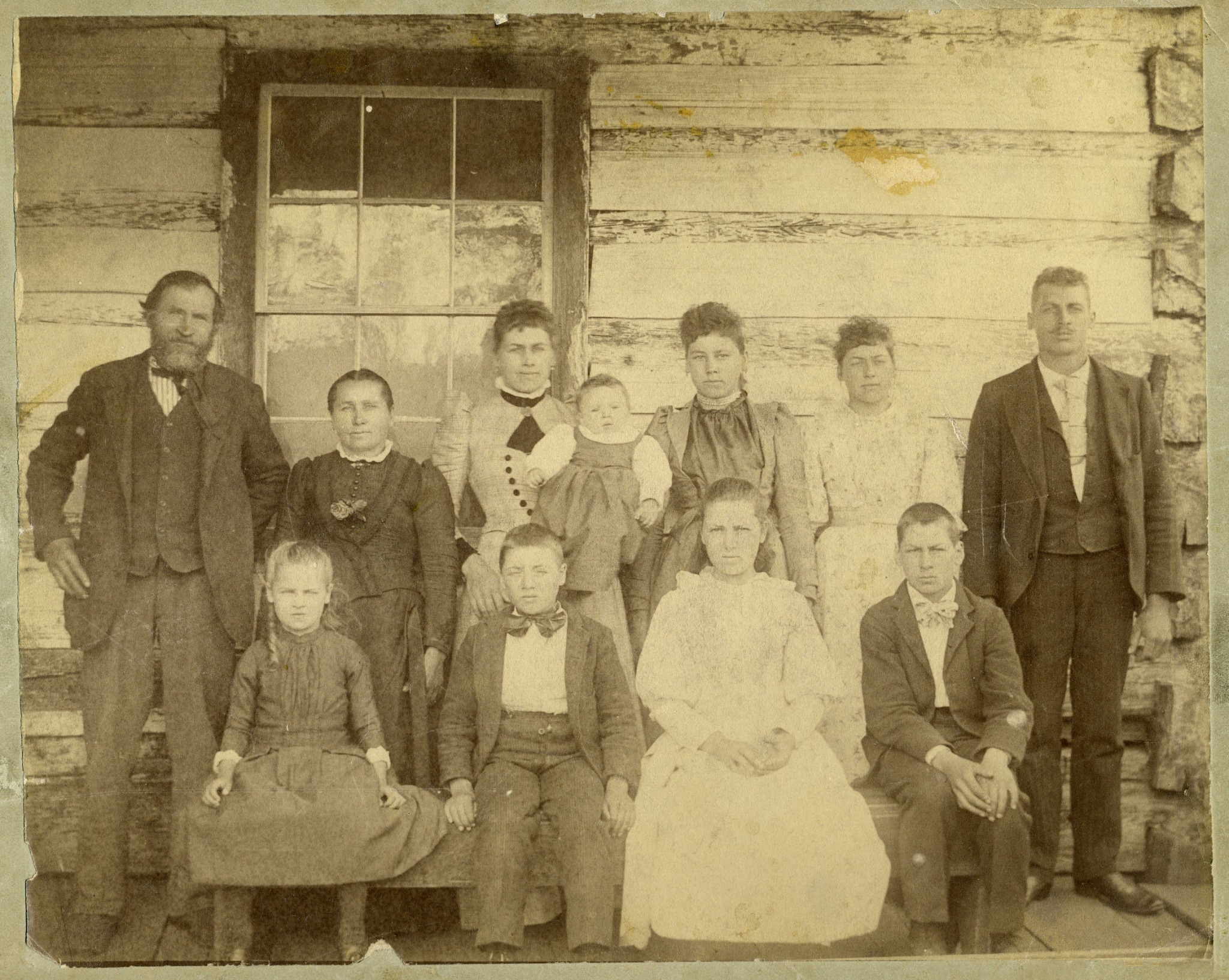
A family funeral photograph dated August 23, 1906 survives, together with an identification key naming Magdalena and several of David's children and relatives. David was buried at Washington Lawn Cemetery.
Family funeral photograph · August 23, 1906
Photograph and identification key to be added.
The next generation
The Farm After David
A legal agreement dated September 27, 1906, concerned the family property and timber after David's death. Current research notes indicate that Magdalena retained a life interest, that merchantable fir and cedar were involved, and that certain first-class cedar was reserved for farm buildings and fencing.
The document also refers to an $800 obligation divided among the sons Reinhold, Otto, and Phillip. The original agreement still needs to be fully transcribed for the website; this summary reflects current research notes rather than a complete interpretation of its legal effect.
The property later divided along family lines. Reinhold's descendants retained part of the original property in Lewis County, while Otto's daughter Eileen Hilpert Townsend and her husband Frank Townsend owned another substantial portion in Thurston County.
Members of the family continued to own substantial portions of the land assembled by David more than a century after he first settled there.
An enduring connection
Legacy
David August Hilpert's life connects revolutionary-era Germany with the settlement of Washington Territory. He began life in Prussia as a silk weaver and ended it as the patriarch of a large Washington family whose descendants retained connections to the land he first began clearing in 1858.
His story continues to evolve. Original letters and records are correcting or refining accounts passed down through the family, bringing his life and the experiences of those around him into clearer view. Preserving those documents alongside the family memories allows future generations to understand both the history and how it has been reconstructed.
Sources & Research Notes
The following source categories guide this biography. Complete citations, scans, transcriptions, and record references will be added as the material is prepared for the archive.
- Surviving Hilpert family correspondence, 1849–1857
- August Hilpert to David Hilpert, 13 January 1850
- August Hilpert to David Hilpert, 29 September 1852
- Washington Centennial Farm records / Hilpert Farm histories
- David Hilpert land and pre-emption records
- Passenger-list research for the Amaranth, 1853
- David and Magdalena Hilpert marriage research
- David Hilpert obituary and funeral records
- Hilpert family photographs and identification keys
- Family oral histories and later recollections
Some later family histories contain claims that conflict with surviving primary documents. Wherever possible, this site distinguishes family tradition from documented evidence and identifies conclusions that remain open to further research.
Have a source or correction to share? Contribute to the family history.