The family’s story
The correspondence begins with brothers still travelling and working in Germany and ends with a nephew trying to repair the family's broken lines of communication. Between those points lie political danger, repeated plans to emigrate, the sale of a home, children growing up in America, illness and bereavement. The writers continually return to the same practical questions: Where are you? Have you received my letter? Can you come? Can you send money? Will we see one another again?
David is the central recipient in the family's 1978 inventory. Several manuscripts call their recipient only “brother,” “brother-in-law” or “uncle,” so the inventory helps identify him without making every identification certain. The sibling group supplied by the family is David, Christel/Christina, August, Ernst and Friedrich. Where a manuscript says only “sister,” identifying her as Christel uses that family context. The inventory itself makes some mistakes: the December 1849 family letter addresses Mother and siblings, and Friedrich's later letter addresses his sister and her children, even though both are listed as letters to David. [H1 inventory; UW 2, 12]
Letter 01
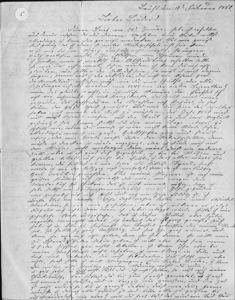
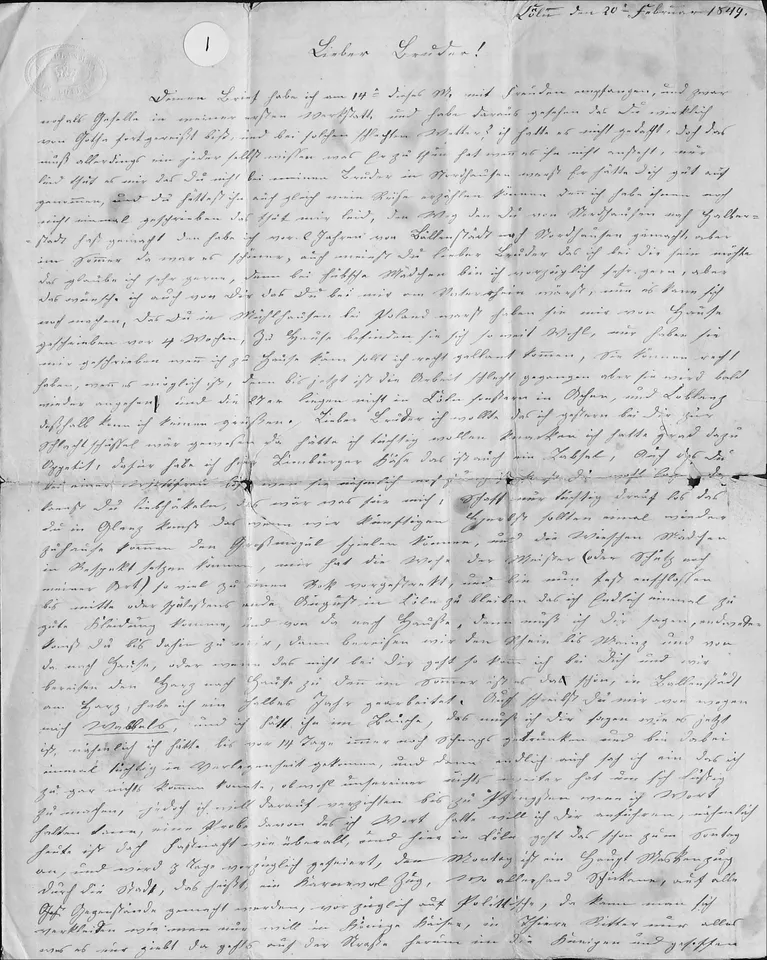
February 20, 1849 — Work, reunion and the possibility of America
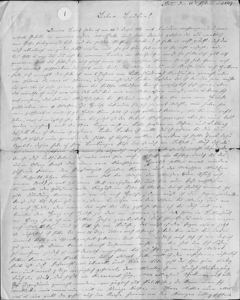
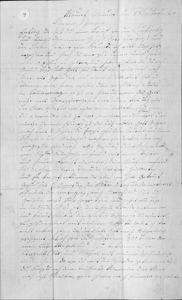
Writing from Cologne, August answered a letter received on February 14. His brother had left Gotha and travelled through northern Germany. August regretted that he had missed their brother in Nordhausen. His own recollection includes work in Ballenstedt and travel from there to Nordhausen; these place names correct earlier readings. These men were already separated by their work, but they imagined meeting again and travelling home together. August proposed a journey along the Rhine toward Mainz, or a route through the Harz. Clothes and money mattered: he wanted to return looking respectable, and an advance from his employer had helped him toward a coat. [Letter 1]
The letter is lively and intimate. August talks about dancing, girls, Carnival and his resolve to give up schnapps for a time. He also reads political news in the workshop's newspaper, the Neue Rheinische Zeitung. He sees the struggles in Hungary and Italy as reasons to hope for change in Germany. Those are his expectations as he wrote, not a prediction that events would fulfil.
America was already under discussion. His brother had asked about it, and August considered going himself. Yet he warned against being carried away by reports of California gold. The surviving sequence will eventually place the recipient in a correspondence involving California, making this early warning especially striking. At this point, however, neither the American voyage nor a California residence had happened in the surviving account. August still wanted to wait for developments in Germany. He ended by supplying requested songs, another way of sharing life across the distance. [Letter 1]
Read the original and translation →Letter 02 & 03
December 16, 1849 — Two letters from a man in hiding
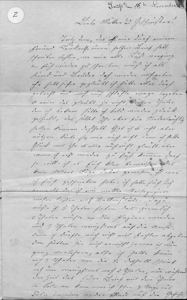
By December, August's circumstances had changed sharply. From Brühl he wrote to his mother and siblings, defending himself against their apparent belief that he had wasted money or misled them. He had found work without the necessary papers, first telling his employer that his passport was being renewed. Eventually he admitted his situation. The employer agreed to keep him, at his own risk, provided August behaved and worked diligently. August remembered the relief of that moment. [Letter 2]
His dependence made him vulnerable. Brassel, a man who had borrowed his coat would not return it, and August feared that pressing too hard might lead to denunciation. He also needed help from home but felt wounded by the way it had been offered. The quarrel should be understood through that unequal evidence: we have August's indignation, not his mother's or sister's explanation.
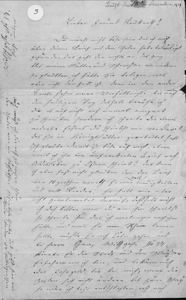
On the same day he wrote separately to his friend Lenkroth, identified in the historical translation and inventory as Gotthold Leukroth/Lenkroth, his brother-in-law. August explained that his anger concerned his mother and sister, not his friend. He asked Lenkroth to tell David how much he wanted to see him. David had not answered an earlier letter, and August wondered whether unpaid postage had offended him. The family was communicating through intermediaries as well as directly. [UW 3; H1 December 16 translation]
These two letters belong together. August referred to the other letter's account of his circumstances and asked that neither be allowed into outsiders' hands. He supplied a concealed correspondence name, best read with the historical translation as Wilhelm Meyer, and a shoemaker's address in Brühl. In the family letter, he instructed them to say he was in Holland. That was a cover story: his actual dateline was Brühl.
The old copies also clarify that police restrictions affected land as well as travel papers. A passage previously misread as referring to an “old father” concerns a half parcel of land placed under attachment pending August's reporting. Its precise historical area should not be converted into an American half-acre. The letter links his hopes of freedom to the possibility of recovering control over his affairs. If conditions did not improve, he contemplated Holland and then America. Neither letter records that journey as accomplished. [UW 3; H1 manuscript, pp. 1–2]
Read the original and translation →Letter 04
January 13, 1850 — Contact restored, and the reason for the danger
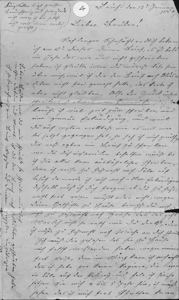
August's January letter opens with relief: his brother's letter had arrived on January 12 after a long silence. The preceding December appeal to Lenkroth fits this renewal of contact, although the letters do not prove that Lenkroth caused the reply. August now set out why he could not simply leave in March. His papers were with the Cologne police; he feared years of imprisonment if he went to collect them. [UW 4; H1 January 13]
He explained his refusal of a Landwehr call-up during the 1849 upheavals. He and others had argued that their obligation was to defend the country, rather than serve the use to which they believed the authorities intended to put them. His account moves from collective refusal to individual insecurity: an order to report, fear of arrest, precarious employment and attempts to find a way to travel. It is a participant's explanation of his actions, not a military service record.
America remained possible, but a brother's timetable could not remove August's lack of papers or money. He discussed ports and passage costs, hoped for amnesty or renewed revolution, and wished the brothers could work in the same town. The practical and emotional threads were inseparable. Even his stolen or ruined coat affected his ability to move, earn and appear respectably before his family. Political verses at the end carried the hope for liberation that the prose could not turn into a definite plan. He posted the letter on January 20. [Letter 4]
Read the original and translation →Letter 05
February 17–22, 1850 — The brothers disagree about leaving
The next letter answers his brother's January 28 letter. The brother still intended to leave, apparently in March. August could not accompany him and imagined receiving a farewell that might mean permanent separation. He wished they could wait until autumn, meet at home and enjoy Leipzig together before deciding. [Letter 5]
Their disagreement also concerned politics. The improved reading concerns revolution on the Rhine and the prospect of suppression by bayonets. The earlier interpretation that his brother dismissed revolution altogether as a sham was too strong. August still hoped political change would solve the difficulty that kept him from travelling openly. He considered a questionable way of using a journeyman's travel book, but said he had not yet risked it. At Carnival he had confronted the man responsible for his coat and received a promise of compensation, not the money itself.
The long letter accumulated songs and later additions. August promised to teach his brother the tunes and apologized in case he repeated something he had already sent. One song had come from his former sweetheart Friederike Winkler in 1845, when he was in Cologne. The earlier reading Henriette is corrected. A separate question to his brother concerns Mother's promise about a bed; it provides no evidence of a marriage promise. August contemplated a visit by May and a move toward Leipzig in June, distinct from his brother's March plan. These passages show songs circulating between people; they do not establish that August wrote all their lyrics. His February 21 postscript also qualifies the reassuring picture of his daily life: arguments with politically hostile fellow workers meant he had to watch what he said. He posted the letter on February 22. [Letter 5]
Read the original and translation →Letter 06
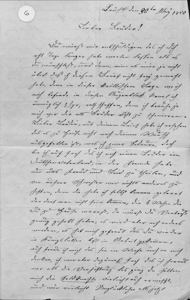
May 30, 1850, as headed — Still in Germany, still hoping to meet
The next letter's heading gives May 30, but its body refers to June events and a proposed July 7 meeting. June 30 is a possible intended date; the discrepancy remains unresolved. Either placement leaves it between February and November in this sequence. [Letter 6]
Its family news is important: the recipient had spent six unhappy weeks at home and had returned to work in Königslutter. August was glad still to have a brother in Germany with whom to share joy and sorrow. Thus the March departure discussed earlier cannot be narrated as a completed emigration merely because it had been planned.
Friedrich had taken August's field on lease. August hoped it would be cared for but also wanted to sell it if that could be arranged safely. Money remained short; even postage was a difficulty. August also describes himself as a freethinker, correcting the earlier word “stranger.” Yet his life was not unrelieved isolation. He described a ball and a Whitsun excursion to the Siebengebirge by train and steamboat, wishing his brother had been there.
He offered to arrange an eight-day visit and mentioned possible work with weavers near Cologne. These are clues to the recipient's working world, not proof of a particular job. A fellow journeyman carried another letter home and could explain August's circumstances orally. The correspondence travelled with workers as well as through the post. The proposed July reunion is not confirmed by a later surviving letter. [Letter 6]
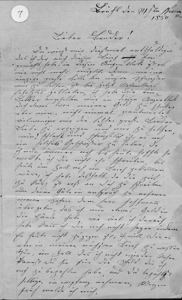
Read the original and translation →Letter 07
November 24, 1850 — Preparing to report
In November, August wrote that he would report the following morning and expected he might be sent after a regiment that had marched out. This was a major change from his earlier account of refusal and concealment. But the letter was written before the intended action: it does not prove that he reported, entered a particular unit or fought. [Letter 7]
He was furious that an appeal to his sister for some of what he called his own money had brought no answer. He had placed belongings with Hoffmann to obtain money against them and told his brother how to deal with his possessions if he did not return. Even amid that anxiety he wanted to ensure that his brother would not lose a thaler owed to him. In the closing prose he had little money and not much hope or courage; the historical translation and renewed manuscript reading support this more discouraged wording. The closing verse nevertheless imagined reunion after separation. His expectation of danger is unmistakable; his subsequent military experience is absent from the surviving sequence.
Read the original and translation →Letter 08
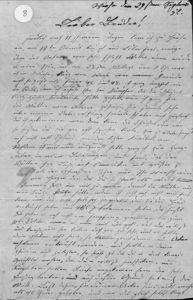
September 29, 1852 — A home being sold, a family preparing to leave
The next surviving August letter comes nearly two years later, from Wiehe. He had left Cologne on September 17 and reached home on September 28 after an eleven-day journey. His mother was surprised and glad to see him. Christel was unwell, with severe hoarseness following childbirth. August's return was therefore both a reunion and an encounter with a household under strain. [UW 8; H1 September 29]
Emigration had become a practical family undertaking. Their mother wanted to go to America. The house had been sold for 450 thalers, with payment or completion expected on October 10. There were arrangements to make about the recipient's land, debts and authority to act on his behalf. August urged his brother to come; if he could not, a power of attorney was needed. Money for the journey and a reserved place were discussed.
The final note set a mid-October departure from Wiehe and embarkation at Bremen; the historical translation and current reading differ over individual day numerals. The secure point is a pressing October schedule, not a verified sailing. August explicitly said he could not yet accompany them. He also wanted his songbook brought to him, or left with a contact in Cologne if they missed each other. The book mattered even while a home was being dismantled.
This letter establishes August alive and writing on September 29, 1852. It does not establish his later fate. The planned migration must be connected to subsequent American letters with care: those letters show a later American family setting, but they do not supply the ship or prove that every October arrangement was carried out exactly as proposed.
Read the original and translation →Letter 09
November 18, probably 1857 — News between Mount Vernon and California
The surviving voice now changes. A brother-in-law writes from Mount Vernon, answering the recipient's news about California. The manuscript does not supply a year. The historical translation explicitly says other correspondence indicated 1857, and the 1978 inventory prints that year in brackets. The inventory identifies the correspondent as Gotthold Lenkroth; the historical translation uses Leukroth and notes the variant Lenkroth. The annotation accompanying Letter 10 favors Leukroth, which is retained alongside the recorded variant. Mount Vernon is identified as Indiana in the historical translation, although the manuscript heading itself does not specify a state. These are useful inherited identifications, kept distinct from the handwritten evidence. [UW 9; H1 November 18]
The letter makes the distance within America personal. The recipient had asked about his mother, sister and Reinhold. The household sent reassuring news. His sister had a young daughter, Reinhold was going to school, and his mother enjoyed the comforts of the household as well as her religious faith. Lenkroth described his shoe business and recalled a house where the recipient had previously stayed. The older copy supports a business figure of 700 dollars and supplies from Cincinnati, correcting the earlier tentative reading of 400 dollars and Boston.
The recipient had also asked about his brother. The family had written to Europe and was waiting for an answer, promising to forward news when it came. The brother is not named in that passage. It cannot securely be turned into a report about August's death or survival. What it does show is an American family still dependent on delayed news from Europe. [Letter 9]
Read the original and translation →Letter 10
June 11, 1859 — Children, recovery and a hoped-for visit
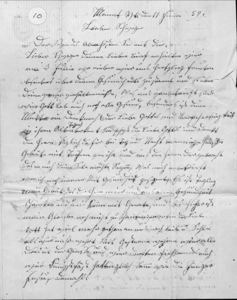
The next Mount Vernon letter acknowledges a letter received June 3. Its brother-in-law signature and household news, reinforced by the old inventory, support identifying the writer with Gotthold Leukroth/Lenkroth. The recipient's mother was still living. His sister had recovered after ten or eleven weeks of chest and lung inflammation during the winter after Christmas. [Letter 10]
Reinhold wanted to see oxen his uncle had bought. His father or household elder joked that perhaps the uncle would bring one, and Reinhold proposed writing to ask that he bring the oxen along. The writer says Reinhold was writing separately; that enclosure has not been identified in these groups. Selma was healthy and two years and five months old. The two letters let us glimpse the children growing up, even though they do not replace records establishing their parentage and exact birth dates.
These children should not be assigned to David simply because they appear in letters he received. Reinhold calls the recipient his uncle. Friedrich's later letter addresses Reinhold and Selma as his sister's children and urges them to support their mother. Taken together, the strongest family interpretation is that they belong to Christel's household and are David's nephew and niece. The connection to Christel is contextual; her name is not written in these particular salutations. [UW 10, 12]
The 1859 letter also discusses a house, German-language news and paving Main Street. The improved reading says the recipient hoped to visit the following summer. It does not describe a plan to take up farming. The letter also says Friedrich was still in Alsleben, correcting the earlier Daniel/Bethlehem reading. Adjacent references to letters and addresses remain too difficult to establish August's survival in 1859. This is correspondence between households with continuing shared interests, not a record of a single uninterrupted migration route.
Read the original and translation →Letter 11
December 25, 1863 — Another branch of the preserved correspondence
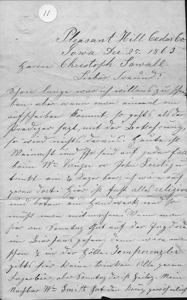
A Christmas letter from Pleasant Hill, Cedar County, Iowa, belongs in the dated collection but has a different relationship: J. B. Lancamp, whose surname spelling remains open to checking, writes to Christoph Sawall as an old friend. It is not a Hilpert brother answering David. [UW 11; H1 December 25]
The writer mixes jokes about Sunday observance and hidden beer with accounts of bitter political hostility, farming and money. He reports 1,200 bushels of corn and 38 pigs, mentions his horses Daniel and Jenny, and anticipates taking office in January. He also gives instructions concerning an agent and funds in Wisconsin, asks after acquaintances and requests a long reply. This letter shows another German-speaking network sustained by friendship, shared business and correspondence. The letters alone do not explain exactly how it became part of the Hilpert family papers.
Read the original and translation →Letter 12
February 17, provisionally 1877 — Friedrich asks to be remembered
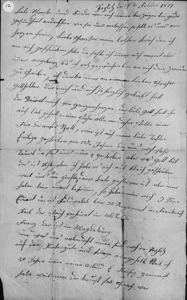
From Poplitz, Friedrich addresses his sister and her children. He had waited in vain for an answer to an earlier letter. He mourned a brother-in-law, whose name is best read Gotthold, and a daughter whose name is tentatively read Emilie. Four children had died; three sons remained: [Eduard], Carl/Karl and Franz. Eduard is the better reading after comparison with the historical translation, replacing Ernst, although the handwriting still warrants caution. Karl was married in Alsleben. Friedrich describes declining strength after years of work on a manor estate and a support payment; the older “pension” and earlier “poor relief” readings do not yet settle its exact type. Emilie is described as the youngest of his sister's godchildren, adding a personal tie between the households. [Letter 12]
His wish was modest and poignant: a letter from the family each year. He asked whether his sister had heard from David and protested that he had done him no harm. He then addressed Reinhold and Selma, wishing them to stand by their mother. Across the earlier and later letters, that corrected pair of names helps connect the Mount Vernon household with the sister to whom Friedrich was writing. A separate historical annotation identifies her as Gotthold Leukroth's widow and says David's children Reinhold and Selma were named after hers. That is a valuable inherited family tradition, not a statement made in Friedrich's letter.
The heading is provisionally read as 1877, also the year in the old inventory. Some internal details still warrant checking, including the son's military location. The daughter must not be automatically merged with the Emilie born in Halle in November 1865: a death at twelve and a half could not already have occurred by February 1877. Either the identification or some reading would have to change. The narrative therefore retains the letter's family losses without importing an unproved baptismal match.
Read the original and translation →Letter 13
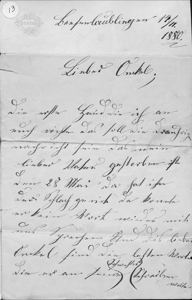
November 14, 1880 — Carl takes up the correspondence
Carl Hilpert's letter to an uncle brings news of his father's death. The old inventory identifies the uncle as David. The historical translation's annotation explicitly identifies Carl as Friedrich's son and David as the uncle. This supports the connection already suggested by the Poplitz household and Friedrich's son Carl/Karl, although Carl does not name his father in the letter itself. He says his father was struck on May 28, probably in 1880, and could no longer speak. [Letter 13]
Carl explained the delay: the uncle's address could not be found. His father's sister's address was also missing, so he asked the uncle to write to her and send it. This is a practical explanation for lost contact. It warns against assuming that every unanswered letter represented rejection or a quarrel.
His mother was still in Poplitz, near his own home in Beesenlaublingen. Carl called himself the second son, aged thirty-one, with three children. He intended to take his father's place in keeping news flowing. The sequence that began with brothers hoping to meet again thus closes with the next generation trying to preserve the connection.
Read the original and translation →What survives of the conversation
The collection preserves an active exchange, but unevenly. We hear David and other recipients indirectly when writers acknowledge their letters, answer their questions, disagree with their opinions and respond to their plans. The February 1849 letter answers one received on February 14; the January 1850 letter answers one received January 12; the February 1850 letter answers one dated January 28; the June 1859 letter answers one received June 3. Those are clear traces of the missing side.
The newly added packet does not supply that missing side. Its five dated manuscript letters duplicate UW Letters 3, 4, 8, 9 and 11. Its six typed translations represent those same five letters, with two versions of the September 1852 translation. No complete outgoing letter by David or matched pair consisting of his letter and the reply was identified in either group. The undated English fragment is later family research, not a newly found Hilpert reply.
What the combined evidence gives us is nevertheless a substantial family story: brothers negotiating work and political danger in Germany; a mother and sister preparing to emigrate; American households exchanging news across considerable distances; relatives in Germany waiting for answers; and a nephew trying to restore contact after a death. Songs, money, greetings and practical favors accompanied the news. The surviving letters do not fill every gap, but they show how much effort the family made to remain present in one another's lives.