Current reading edition
English translation
Square brackets mark uncertain words or editorial explanations. Songs are translated for meaning; their speakers are not necessarily the writer.
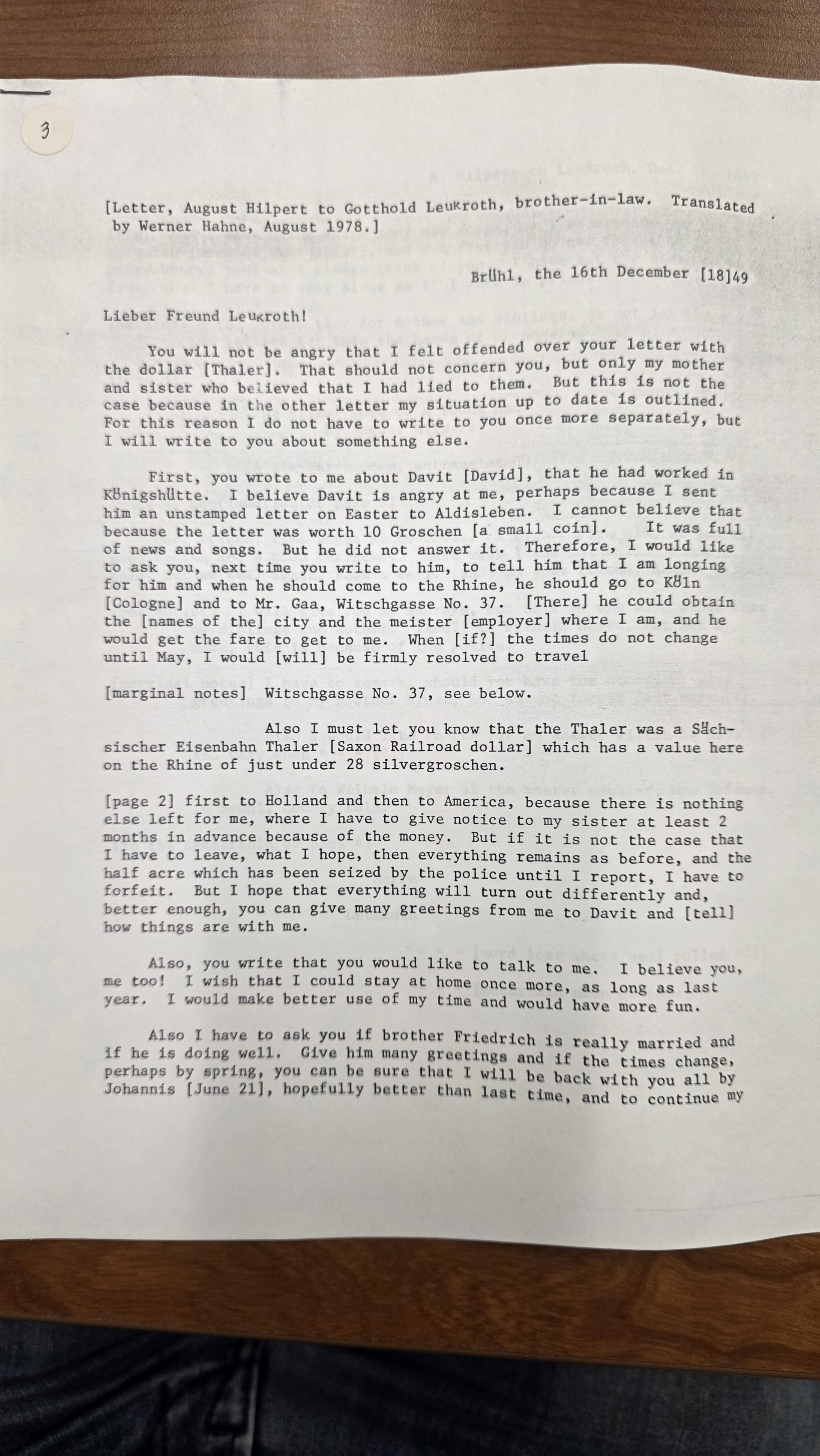
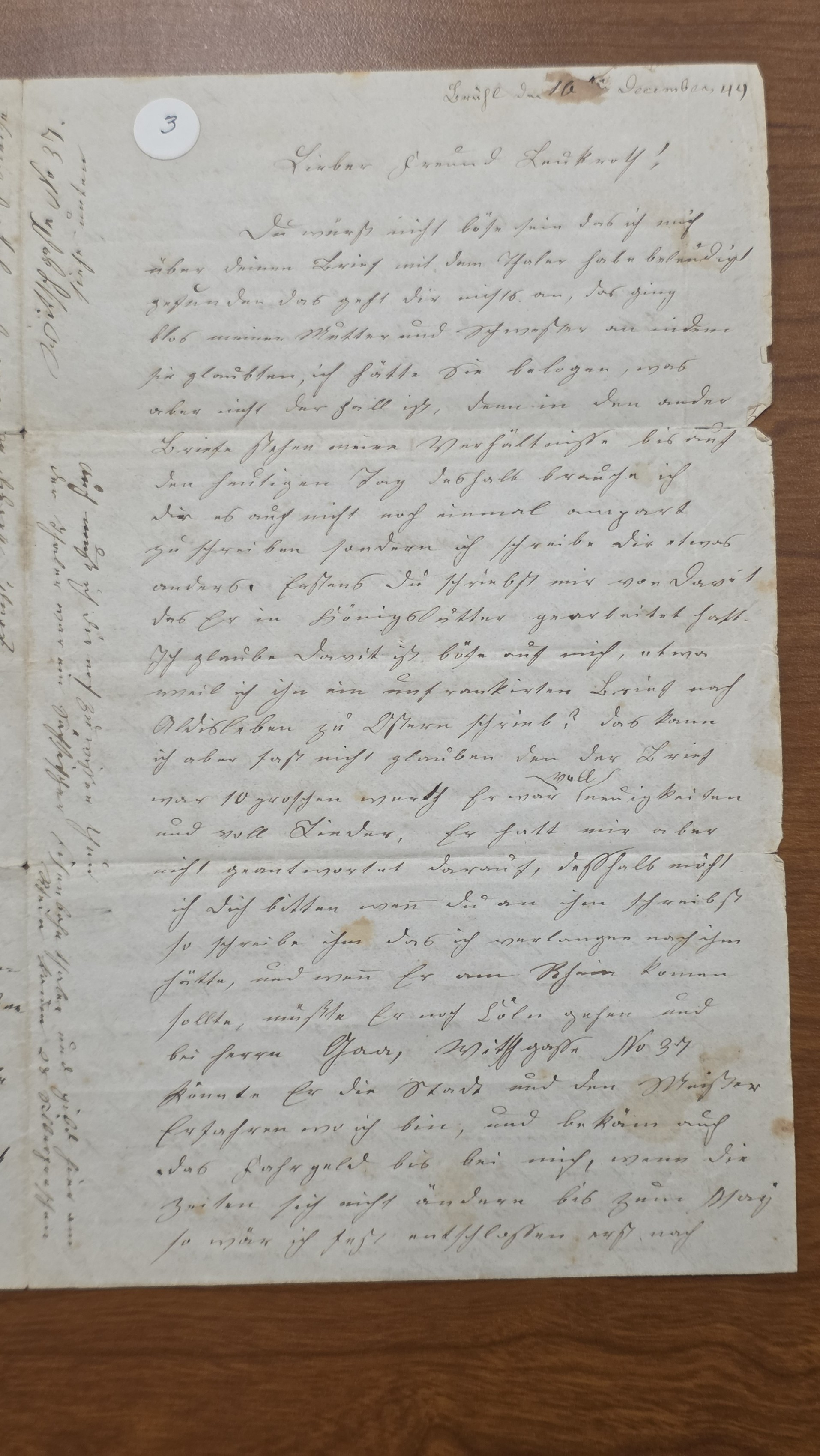
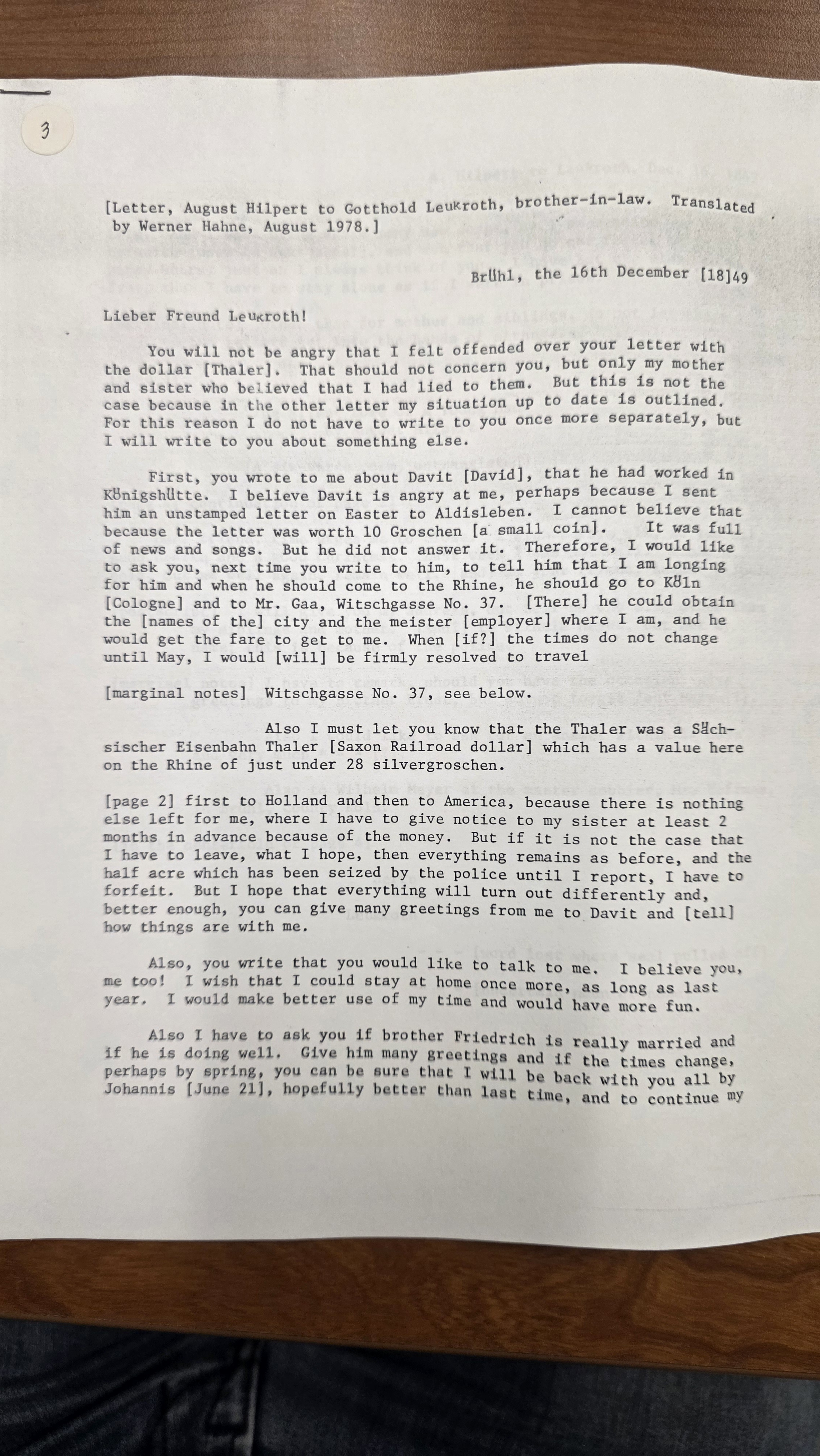
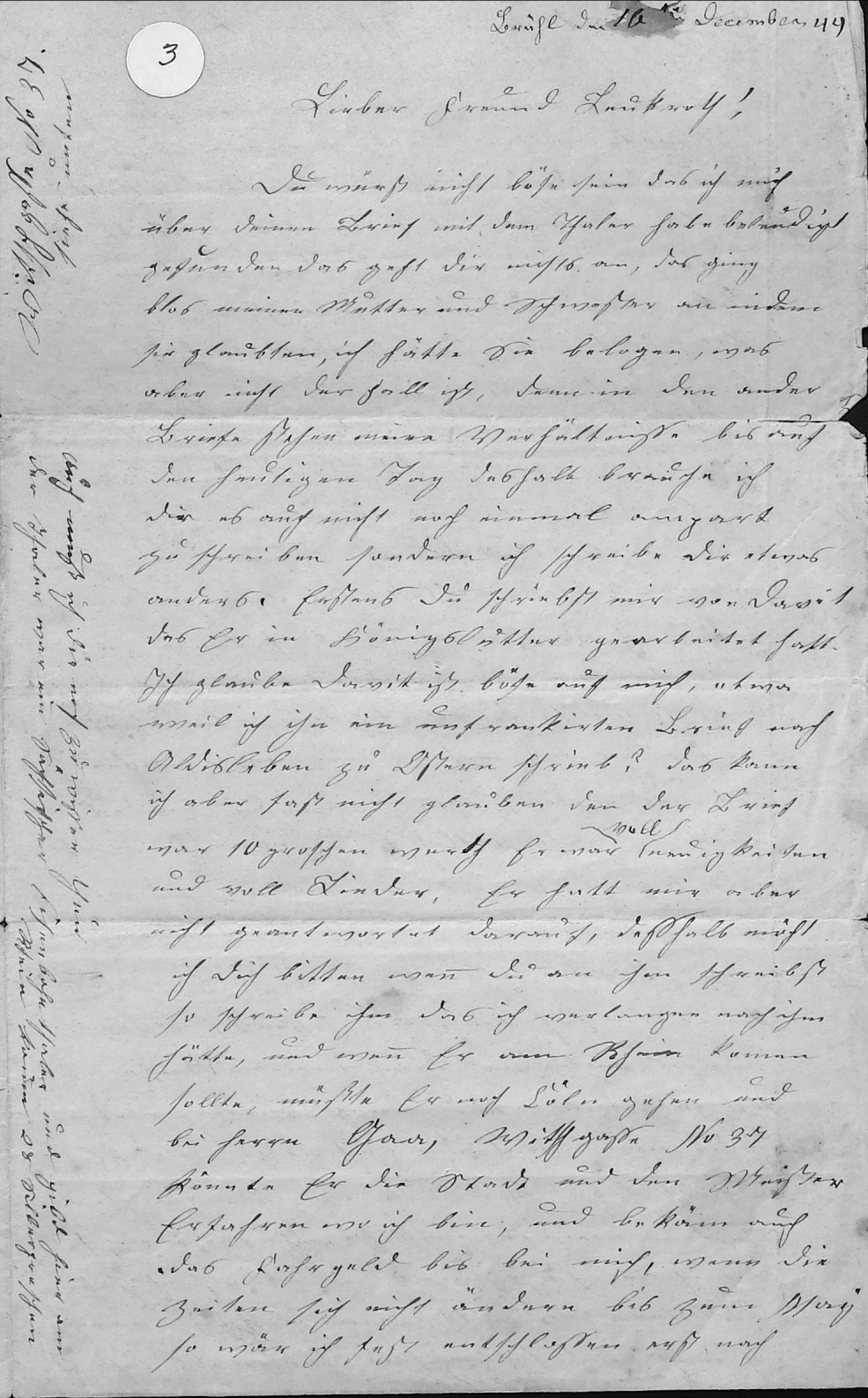
Download the English text ↓Brühl, December 16, 1849
Dear friend [Leukroth/Lenkroth],
You must not be angry that I [felt offended — likely “beleidigt gefunden,” with irregular grammar] about your letter with the thaler. That was not directed at you; it concerned only my mother and sister, because they believed I had lied to them, which was not the case. The other letter describes my circumstances up to the present day, so I do not need to write all of that to you again; instead, I shall write about something else.
First, you write to me about David [spelled “Davit”], that he worked in Königslutter. I think David is angry with me—perhaps because at Easter I sent him a letter to [Oldisleben] without prepaying the postage? But I can scarcely believe that, because the letter was worth ten groschen: it was full of news and full of songs. Yet he has not answered it. Therefore I must ask you, when you write to him, to tell him that I long to see him.
If he should come to the Rhine, he would need to go to Cologne. At Mr. [Gaar's], [street name uncertain], No. 37, he could find out the town and the master where I am, and he would also receive the fare to reach me.
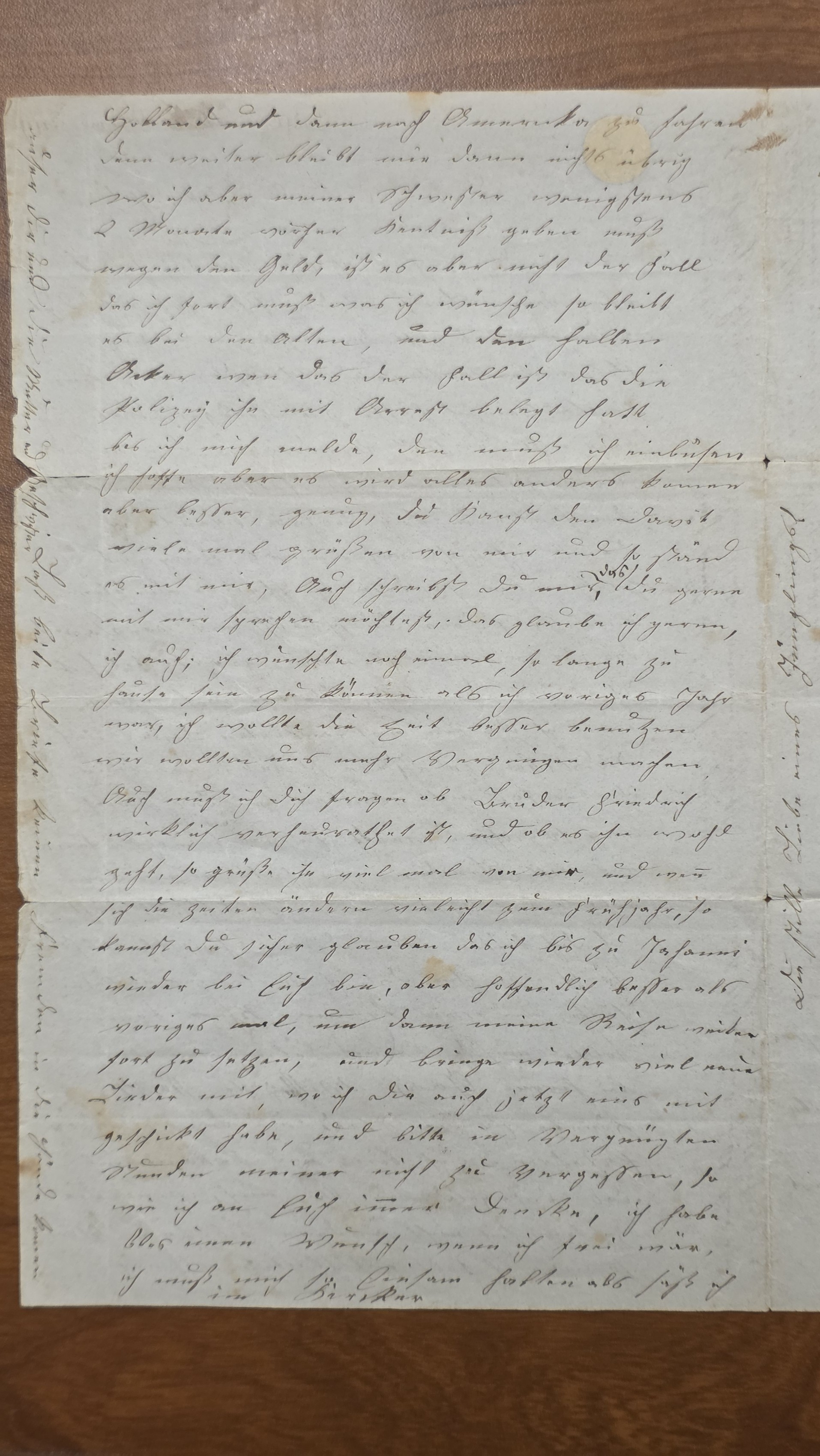
If circumstances do not change by May, I would be firmly resolved to go first to Holland and then to America, because then nothing else would remain for me. But I would have to notify my sister at least two months beforehand because of the money.
If, however, I do not have to leave—which is what I wish—then things will remain as before. As for the half parcel of land, if it is true that the police have placed it under attachment until I report myself, then I must [forfeit it; the exact wording is uncertain]. But I hope everything will turn out differently, and better.
Enough of that. Give David my greetings many times over; that is how matters stand with me.
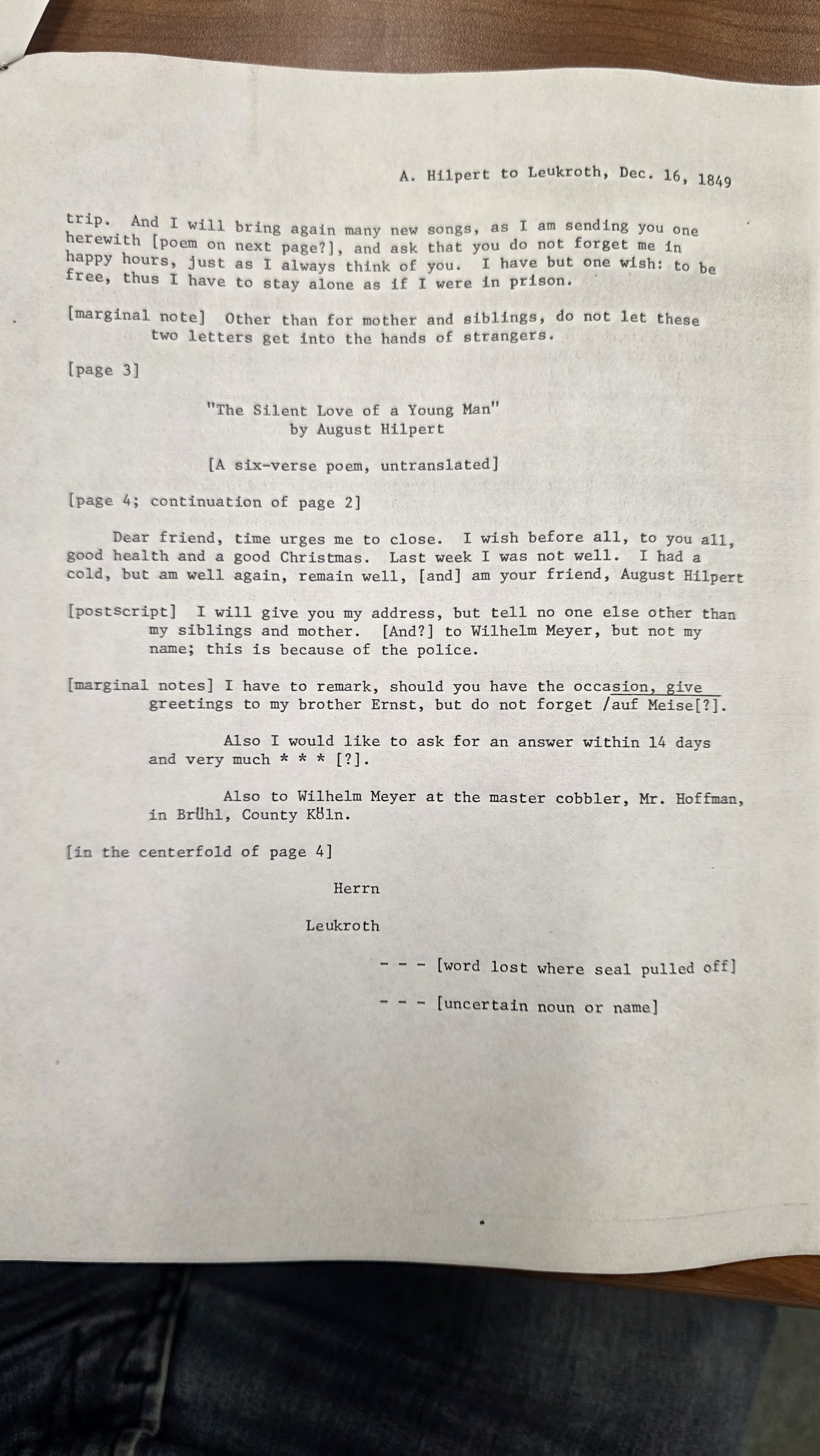
You also write that you would like to talk with me. I readily believe that; so would I. I wish I could once again stay at home as long as I did last year. I would make better use of the time; we would enjoy ourselves more.
I must also ask you whether Brother [Heinrich?; the historical translation reads Friedrich] really is married and whether he is doing well. Give him many greetings from me.
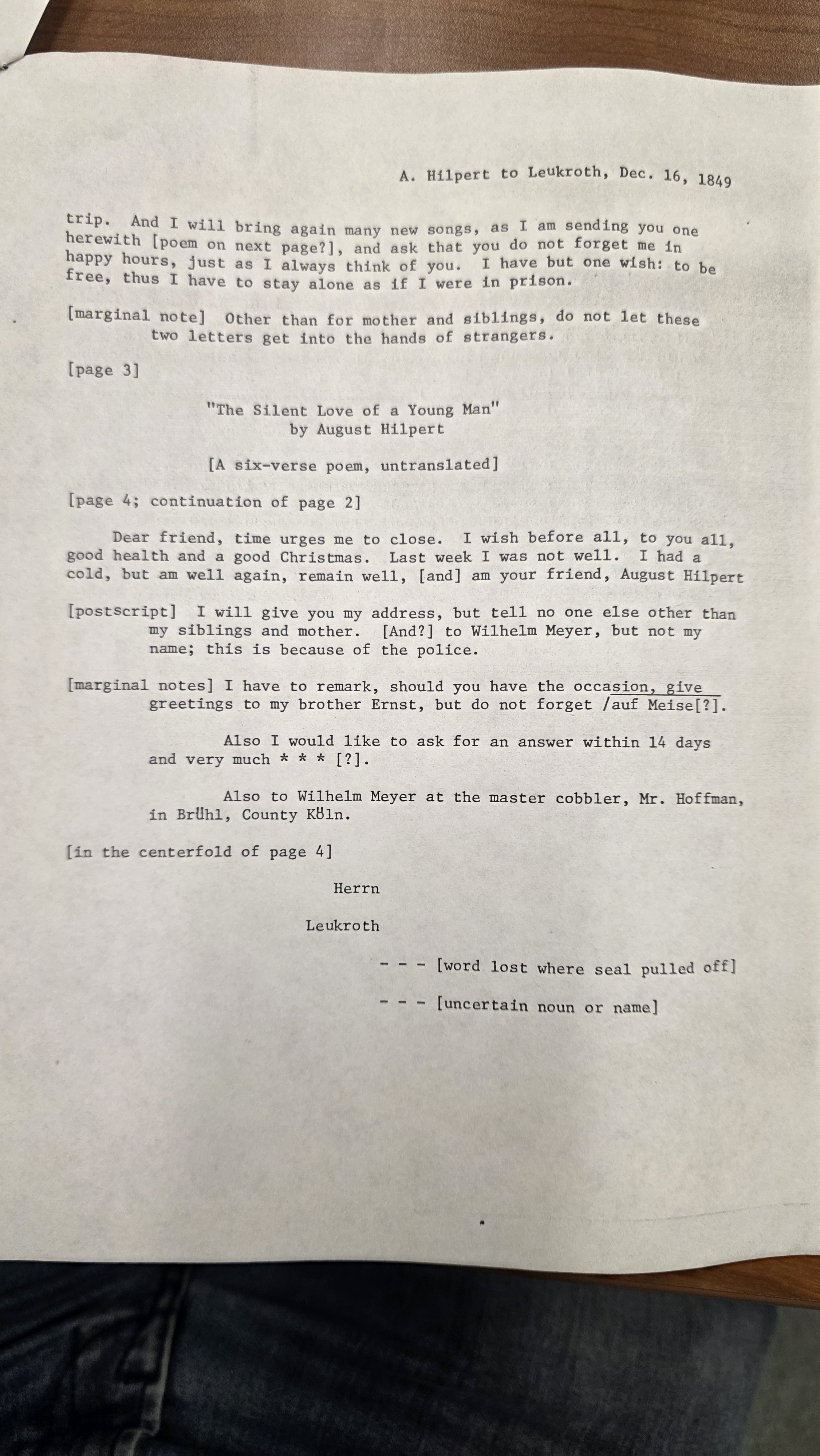
If circumstances change, perhaps in the spring, you may confidently believe that I will be with you again by St. John's Day [Johanni], but hopefully in better circumstances than last time, before continuing my travels. I shall bring many new songs again, just as I have sent you one now. I ask you not to forget me in your happy hours, just as I always think of you.
I have only one wish: if I were free, [the remaining sentence about freedom and the princes is not securely deciphered; do not treat a guessed rendering as a quotation].
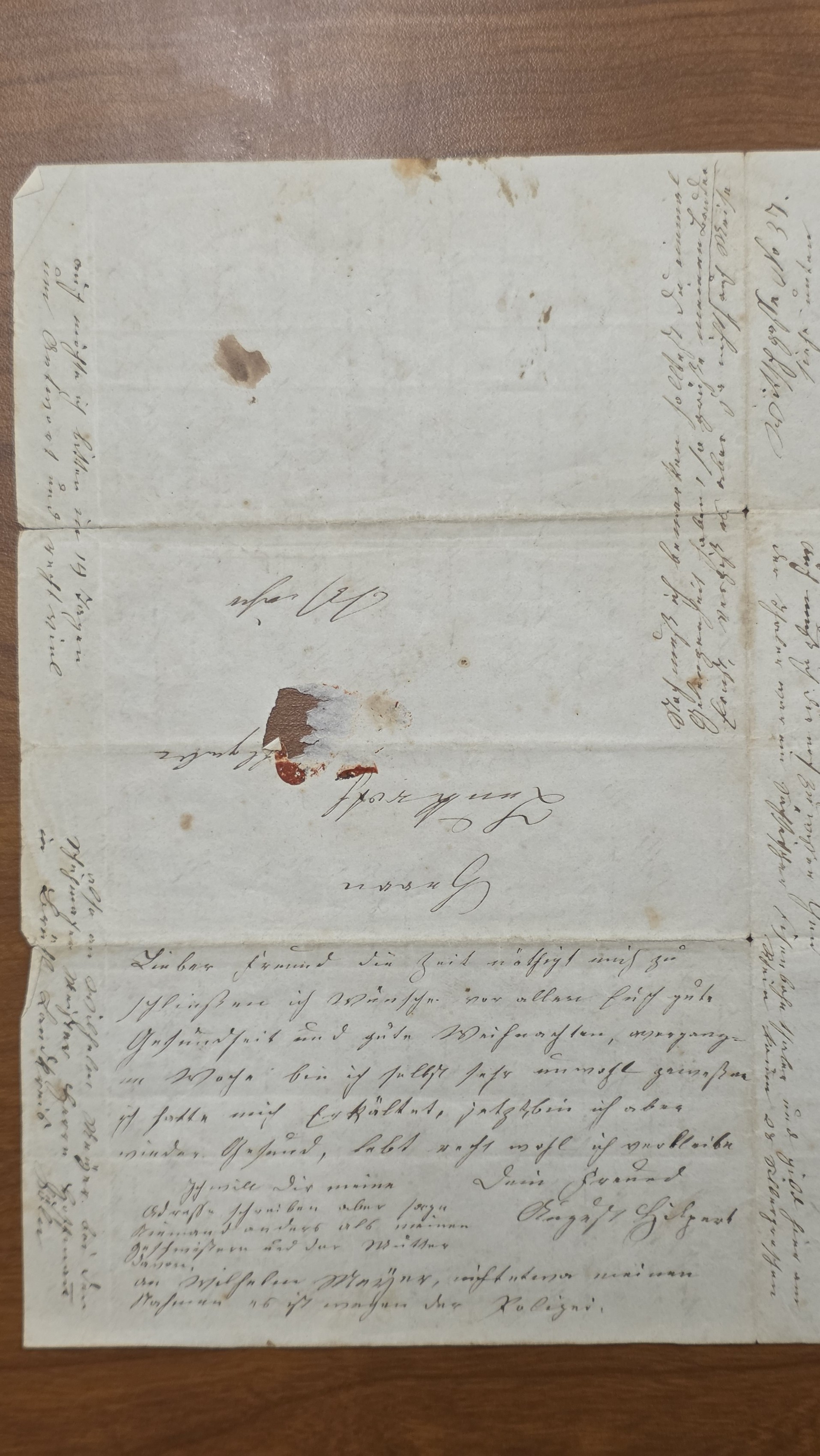
Closing, on the address side
Dear friend, time obliges me to finish. Above all, I wish you good health and a good Christmas. Last week I myself was very unwell; I had caught a cold, but now I am well again. Farewell. I remain,
Your friend,
August Hilpert
Address and marginal additions
These additions are presented separately because they run in different directions around the folded sheet. Their reading order is editorial.
- Confidentiality, continuation page: “[Show/give — opening uncertain] this to my mother and siblings; do not let either letter fall into anyone else's hands.” The instruction concerning both letters is clear and links this correspondence with the companion family letter.
- Concealed correspondence name, beneath closing: “I will write you my address, but tell no one except my siblings and mother: to Wilhelm Meyer, not under my name; it is because of the police.”
- Return address, outer margin: “Thus, to Wilhelm Meyer, at master shoemaker Mr. [surname uncertain], in Brühl, district of Cologne.” The trade appears to read Schuhmacher Meister. This identifies the person at the delivery address, not conclusively August's own trade. Do not expand the employer's surname from conjecture.
- Reply requested: “I would also ask for an answer in fourteen days, and [remaining words uncertain].”
- Greetings, opposite margin: “I must also mention: should you have an opportunity, give my brother Ernst my greetings, [Moritz?] [remainder uncertain, apparently concerning coming to Wiehe].” “meinen Bruder Ernst” is the strongest part of this reading. The next name and the rest of the sentence need another reading.
- Currency, opening margin: “I must also let you know: the thaler was a Saxon [thaler], and here it is worth only [twenty-eight] silver groschen.” There is an insertion referring to the sister, which remains partly unresolved. The number reads 28, but the exact full sentence is not established.
- Cologne address, short marginal repetition: a street name and “No. 37,” followed by “say otherwise …” [fragment uncertain]. The street is not securely read; retain the image rather than inventing a modern address.
Outgoing address panel: “To Mr. [Leukroth/Lenkroth], [damaged descriptor], Wiehe.”
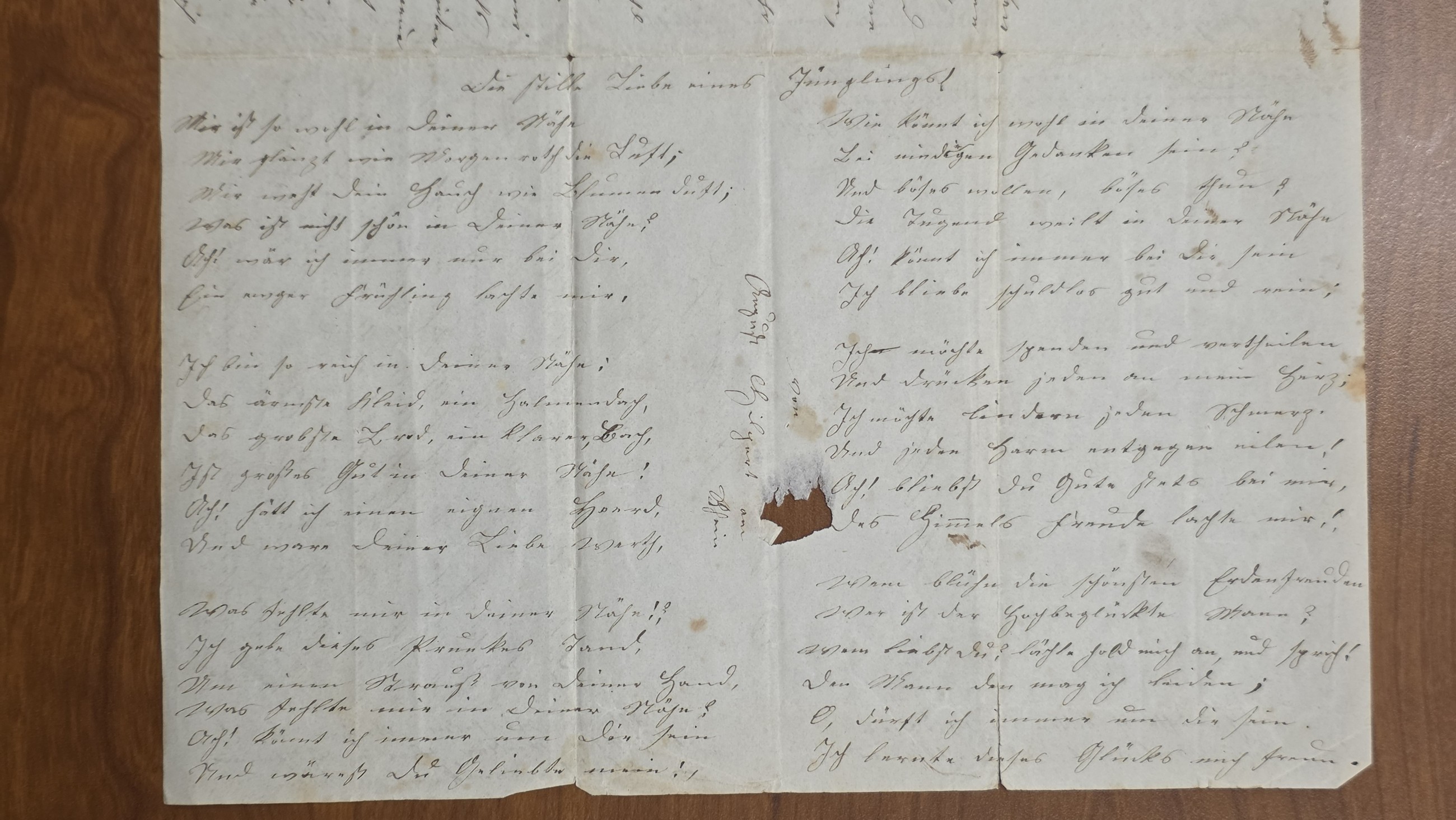
Enclosed verse — working English translation
The handwritten heading reads “Die stille Liebe eines Jünglings” — “A Young Man's Silent Love.” The translation follows the six handwritten stanzas; it does not attempt to reproduce their rhyme. Two difficult passages are left visibly uncertain.
1
I feel so happy near you;
the air shines for me like the dawn.
Your breath wafts toward me like the scent of flowers.
What is not beautiful near you?
Oh, if only I could always be with you,
an everlasting spring would smile upon me.
2
I am so rich when I am near you;
the poorest clothing, a [thatched roof — “Haberdach” appears to be the manuscript wording; uncertain],
the coarsest bread, a clear spring,
are great riches when I am near you.
Oh, if only I had a hearth of my own
and were worthy of your love!
3
What would I lack when near you?
I would give [uncertain phrase, apparently something precious]
for just a bouquet from your hand.
What would I lack when near you?
Oh, if only I could always be about you,
and you, beloved, were mine!
4
How could I, when near you,
entertain base thoughts,
wish evil or do evil?
Virtue dwells near you.
Oh, if only I could always be with you,
I would remain innocent, good and pure.
5
I would give and give away,
and press everyone to my heart.
I would soothe every sorrow
and hasten to meet every heart.
Oh, if you, good one, would always stay with me,
heaven's joy would smile upon me!
6
For whom do earth's loveliest joys bloom?
Who is the man so richly blessed?
At whom do you, sweet one, smile kindly and say,
“That is the man I like”?
Oh, if only I might always be near you,
I could rejoice in that happiness.
[August sends this song; his authorship is not established.]