Current reading edition
English translation
Square brackets mark uncertain words or editorial explanations. Songs are translated for meaning; their speakers are not necessarily the writer.
Download the English text ↓Page 1
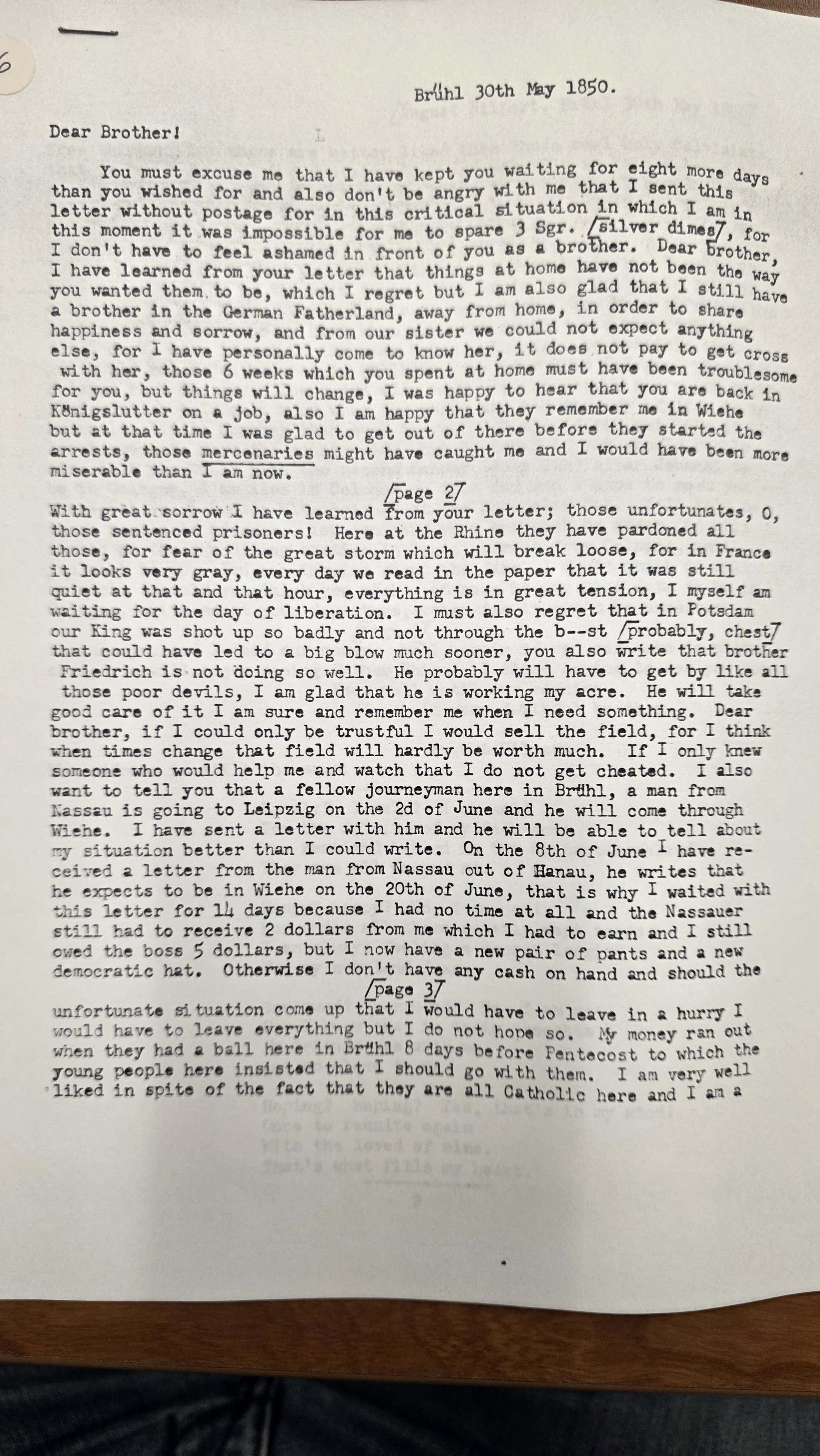
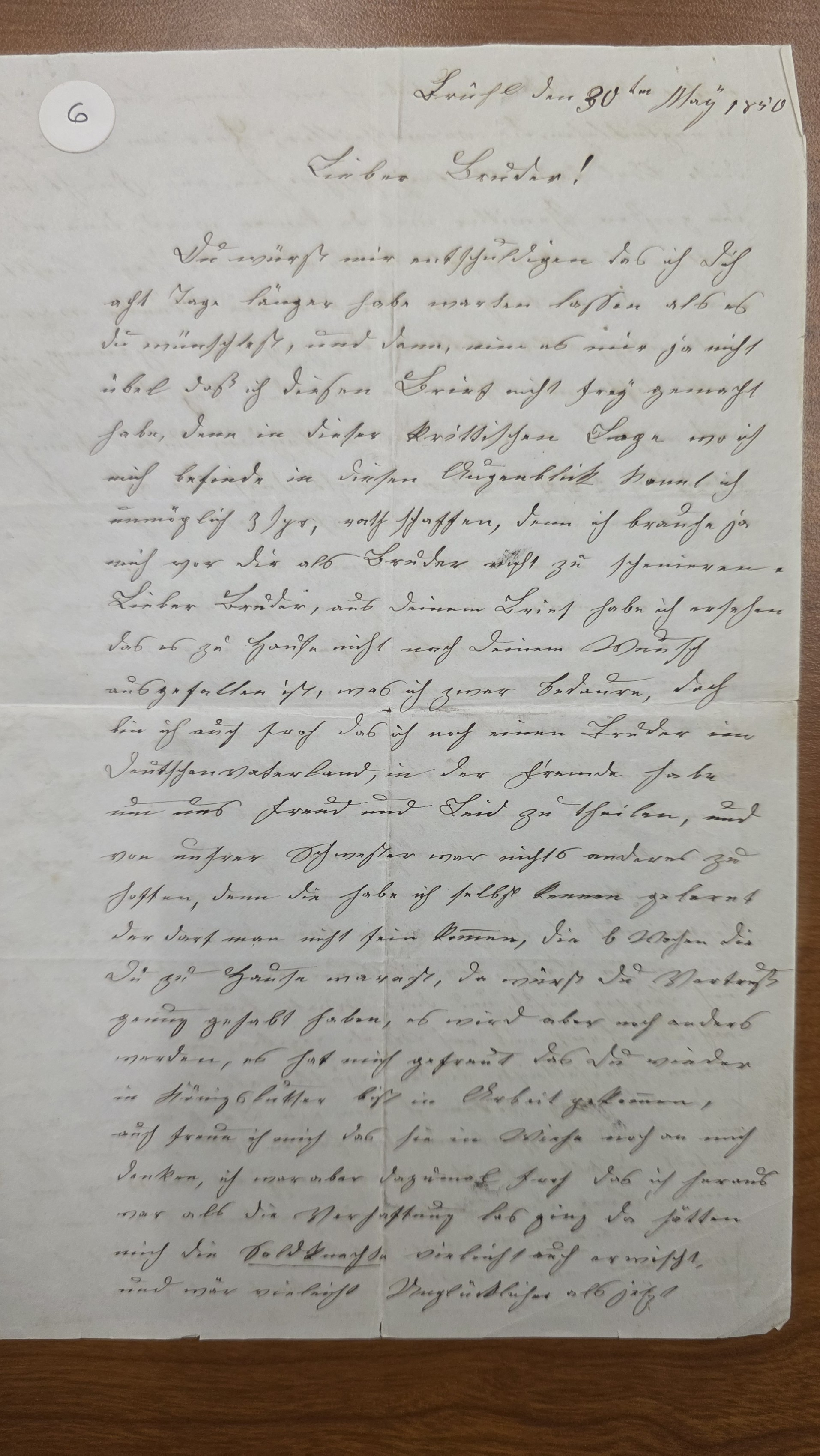
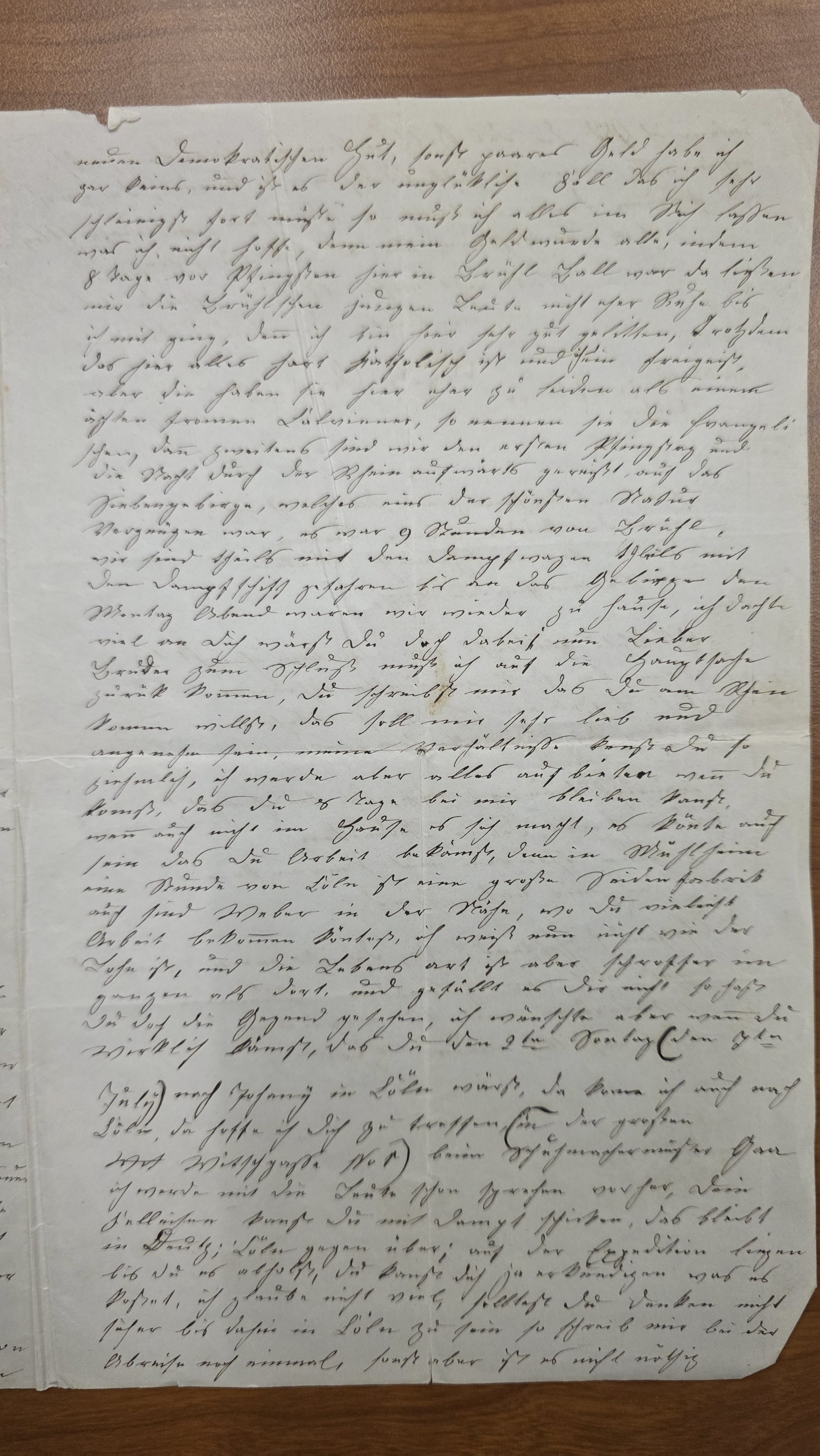
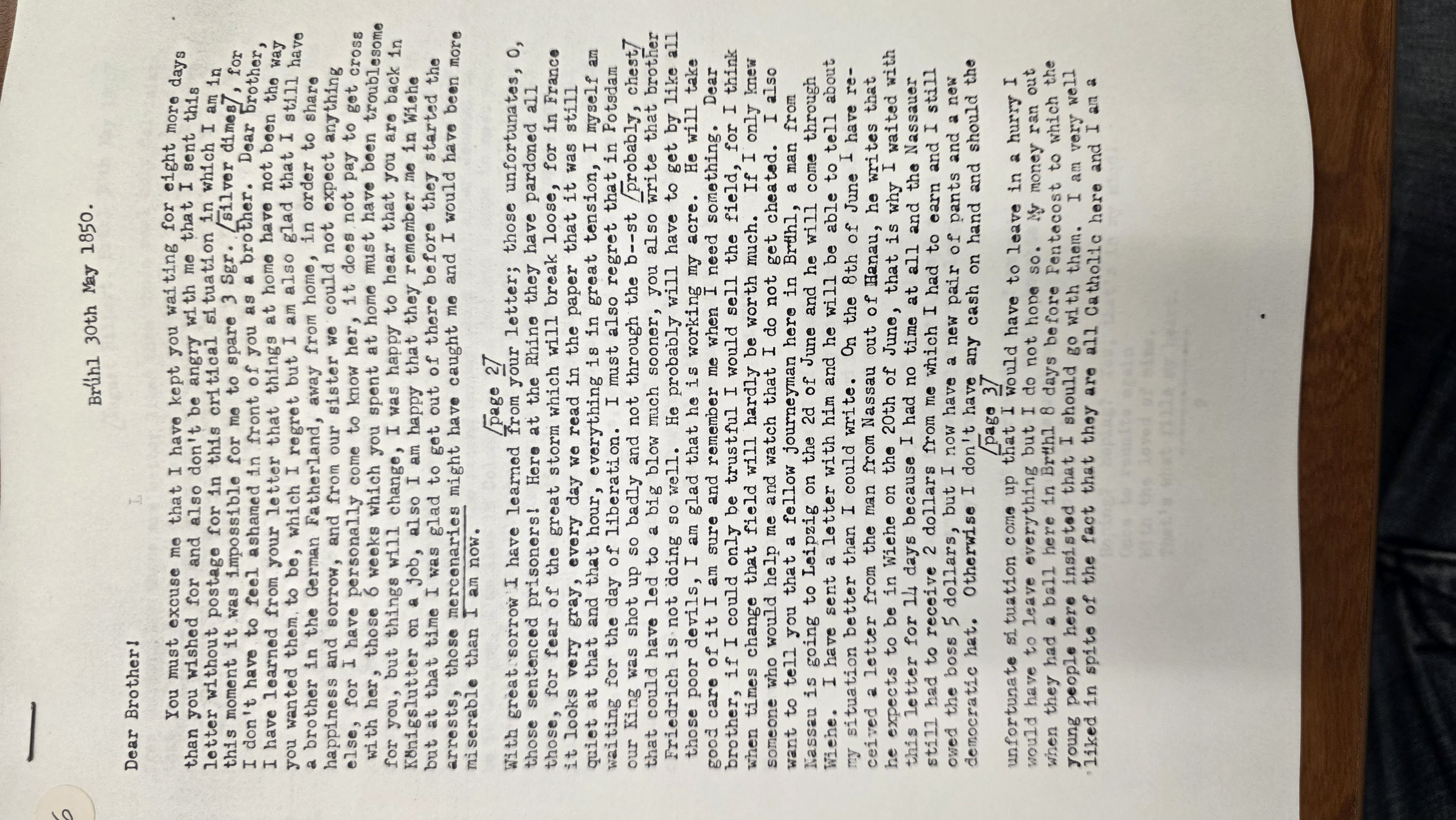
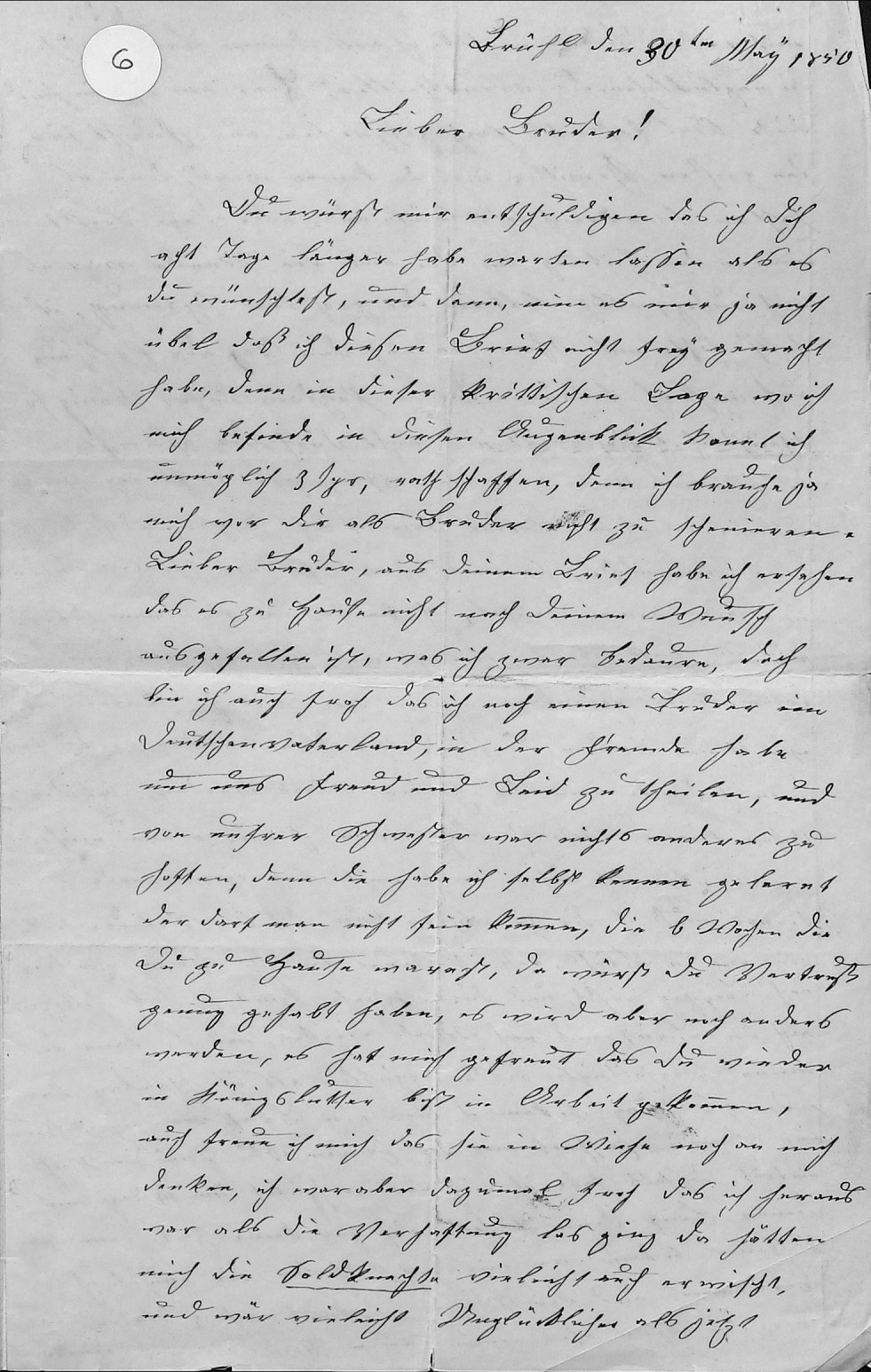
Brühl, May 30, 1850 [heading as written; internal June dates conflict with it]
Dear Brother,
You will forgive me for making you wait eight days longer than you wished. And please do not take it amiss that I have not prepaid this letter. In the difficult position I find myself in at this moment, I simply cannot raise three silver groschen. After all, I need not be ashamed before you, my brother.
Dear Brother, from your letter I learned that things at home did not turn out as you wished. I certainly regret that, although I am also glad that I still have a brother away from home in our German fatherland, with whom to share joy and sorrow.
Nothing else could have been expected of our sister. I learned that for myself: one cannot stay there. During the six weeks you were at home you must have had vexation enough. But things will change yet.
I was pleased that you have found work again in Königslutter. I am also glad that they still think of me in Wiehe. Yet I was glad at the time that I was away when the arrests began. The [“soldiers' henchmen”—the underlined word appears to be Soldknechte] might have caught me too, and I would perhaps be even more unfortunate than I am now.
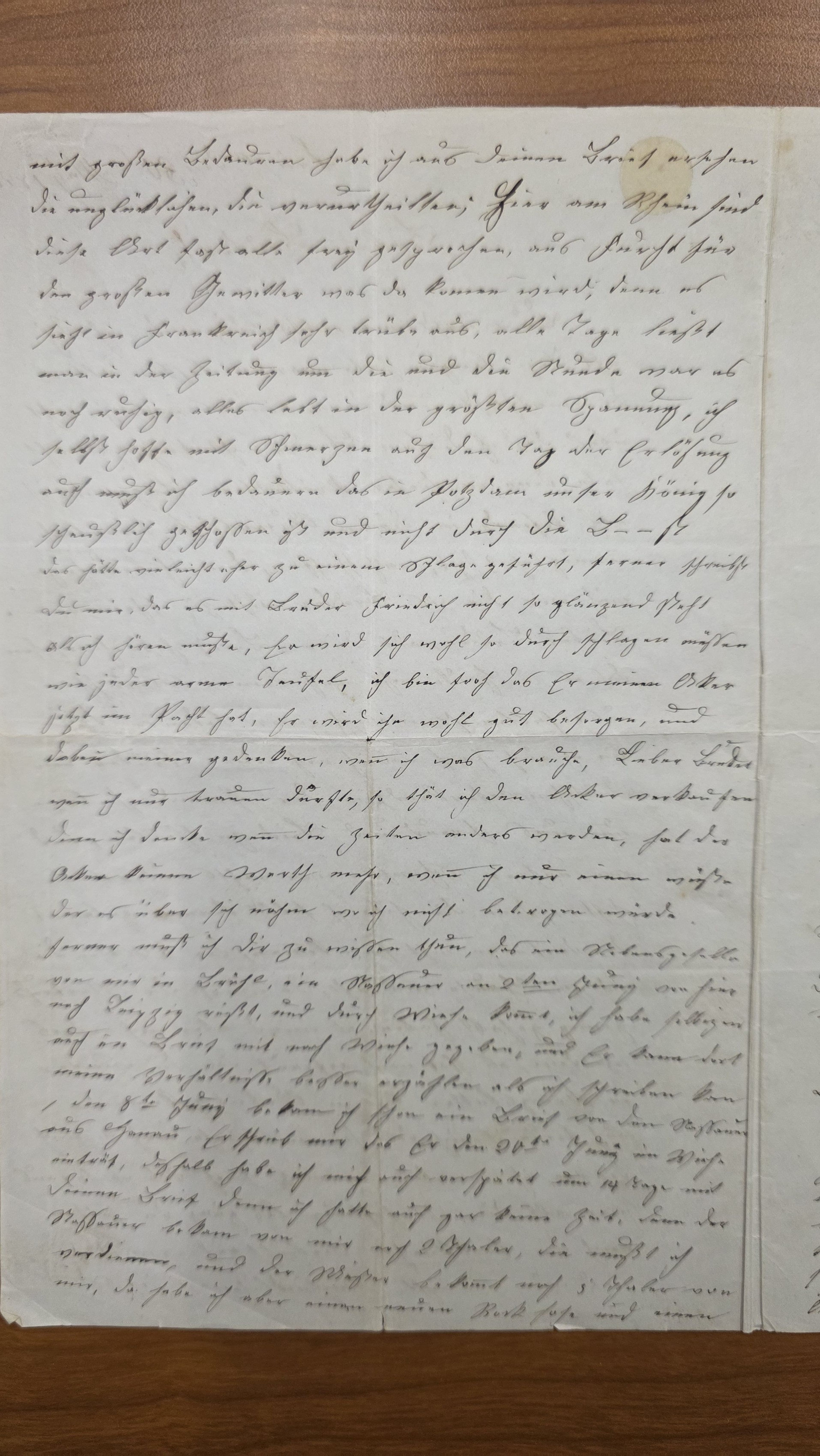
Page 2
It was with great regret that I learned from your letter about the unfortunate people who have been sentenced. Here on the Rhine almost all such people have been acquitted, out of fear of the great storm that is coming. Things look very troubled in France. Every day one reads in the newspaper that at such-and-such an hour things were still quiet. Everyone lives in the greatest suspense. I myself long painfully for the day of deliverance.
I must also regret that our king was shot so badly at Potsdam and not through the [chest?—the word is abbreviated in the manuscript]. That might perhaps have led sooner to a decisive blow [the political implication of “Schlag” is not fully explicit].
You also write that things are not going as splendidly for Brother Friedrich as I would wish to hear. He will have to struggle through like every poor devil. I am glad that he now has my field on lease. He will surely look after it well, and remember me when I need something.
Dear Brother, if only I were allowed to come, I would sell the field. I think that when times change, the field will no longer have any value. If only I knew someone who would undertake it, so that I would not be cheated!
I must also let you know that a fellow journeyman of mine in Brühl, a man from Nassau, left here on June 2 [month reading; conflicts with heading], travelling to Leipzig by way of Wiehe. I also gave him a letter to take to Wiehe. He can describe my circumstances there better than I can in writing.
On June 8 [same dating caution] I already received a letter from the man from Nassau, sent from Hanau. He writes that he will arrive in Wiehe on June 20. That is also why my letter to you has been delayed by fourteen days. I had no time either: the man from Nassau received another two thalers from me, which I had to earn. And the master is still owed [five?] thalers by me. But in return I have a new coat, trousers, and a—
Page 3
—new democratic hat. Apart from that, I have no money at all, and that is the unfortunate part. If I had to leave here in a hurry, I would have to leave everything behind, which I hope will not happen.
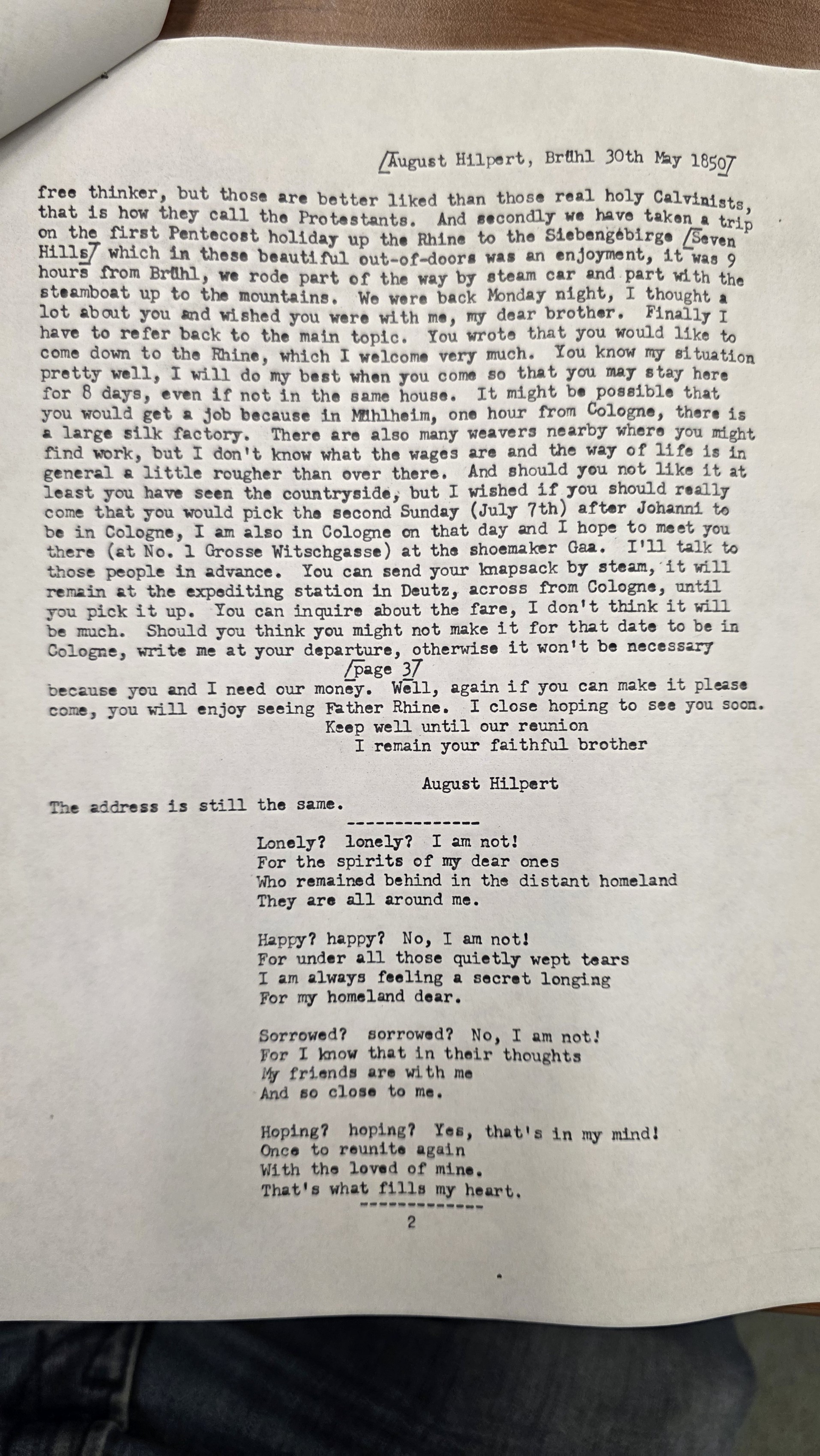
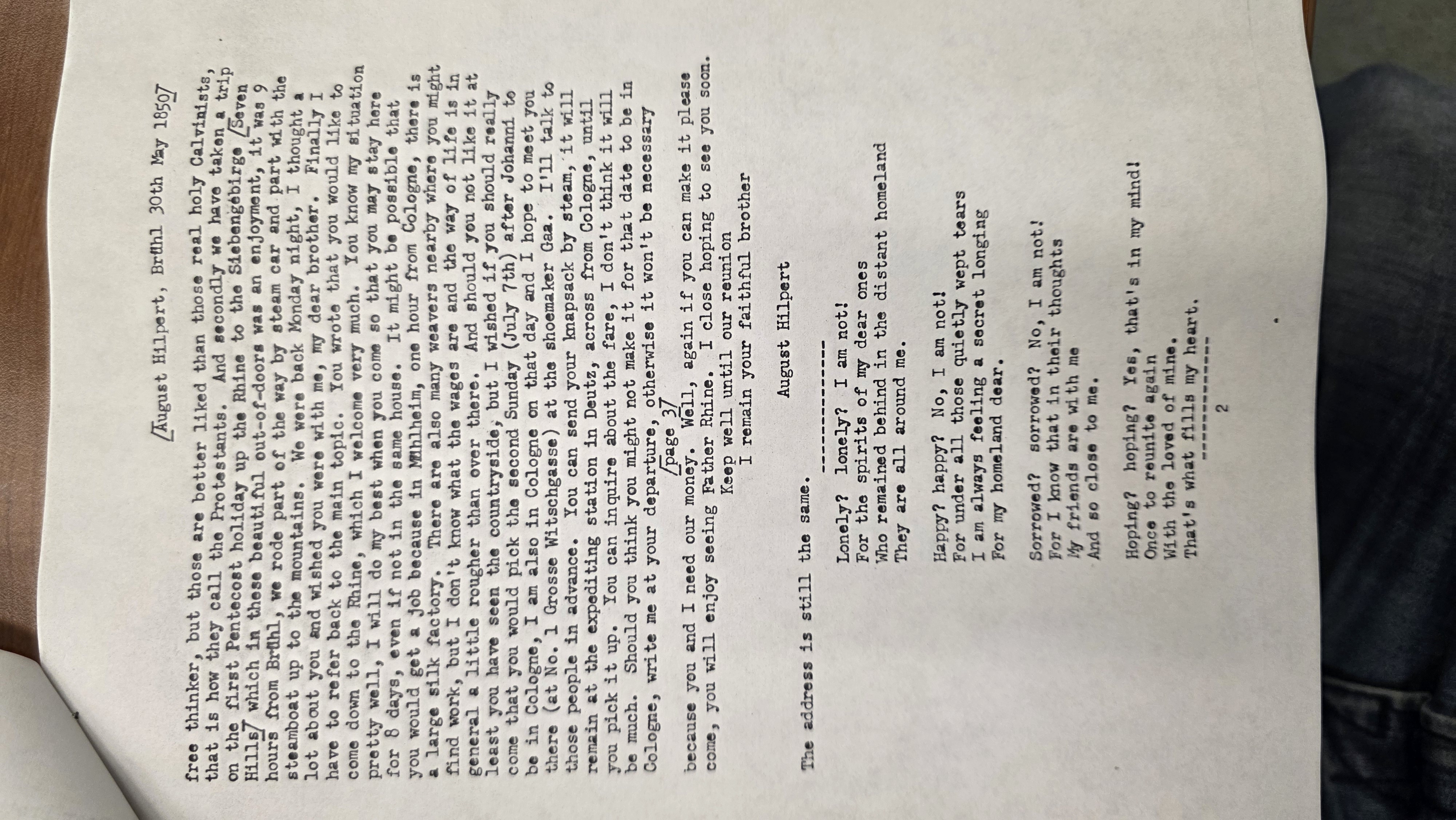
All my money was used up because, eight days before Whitsun, there was a ball here in Brühl. The young people of Brühl would not leave me in peace until I went along. I am very well liked here, even though almost everyone here is Catholic and I am a freethinker. They would sooner put up with me here than with one of their pious [“Lutherans”—slightly uncertain spelling]; that is what they call the Protestants.
Secondly, on Whitsunday we travelled up the Rhine, continuing through the night, to the Siebengebirge. It was one of the loveliest pleasures in nature. It was nine hours from Brühl. We travelled part of the way by steam train and part by steamboat to the mountains. On Monday evening we were home again. I thought of you a great deal—if only you had been there!
Dear Brother, to finish I must come back to the main matter. You write that you want to come to the Rhine. That would make me very happy. You know roughly what my circumstances are. But when you come I will do everything I can so that you can stay with me for eight days, even if not in the house where I am staying.
It might also be possible for you to find work. In Mülheim, an hour from Cologne, there is a large silk factory, and there are also weavers nearby where you might get work. I simply do not know what the wages are. The way of life here is generally rougher than there. Even if you do not like it, you will at least have seen the area.
If you really come, I would like you to be in Cologne on the second Sunday after St. John's Day, July 7. Then I can come to Cologne too. I hope to meet you at the master shoemaker [Gaa?], in Große Witschgasse, No. [4?]. I will speak to the people there beforehand.
You could send me your suitcase in advance. It will remain at the forwarding office in Deutz, opposite Cologne, until you collect it. You can ask what it costs; I do not think it will be much.
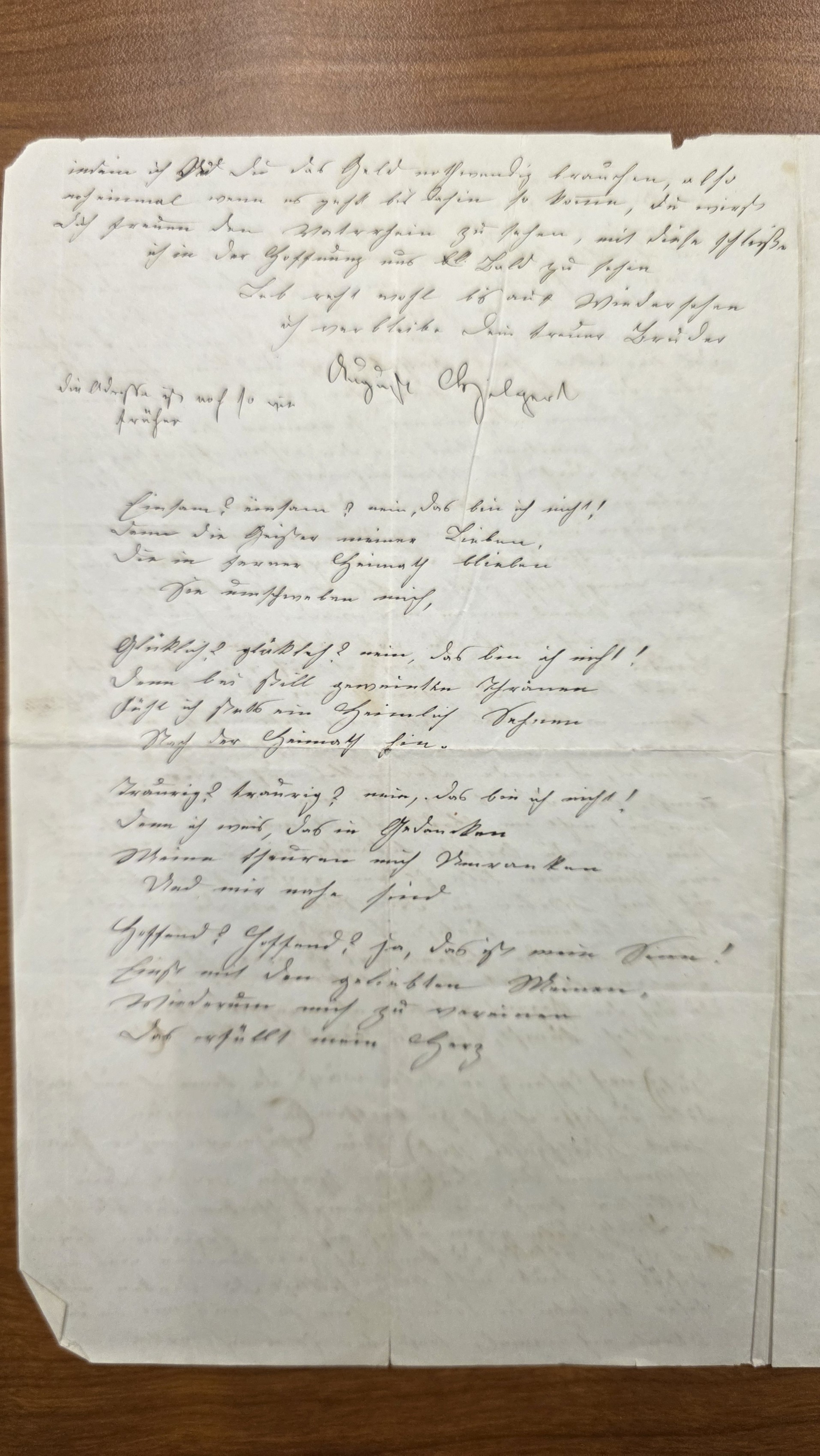
If you think you cannot be certain of being in Cologne by then, write to me once more when you set off. Otherwise it is not necessary—
Page 4: conclusion and address note
—since [both you and I] need the money [wording at the start of this continuation is uncertain]. So once again: come by then if possible. You will be glad to see Father Rhine.
With this I close, hoping that we shall see one another soon.
Fare very well until we meet again.
I remain your faithful brother,
August Hilpert [family spelling]
The address is still the same as before.
Page 4: appended song
[No title or author is supplied in the manuscript. The four stanzas below follow August's order and wording, including his variation in the second stanza.]
Lonely? Lonely? No, I am not!
For the spirits of my loved ones,
Who remained in our distant homeland,
Hover all around me.
Happy? Happy? No, I am not!
For amid tears shed silently,
I always feel a secret longing
For my home.
Sad? Sad? No, I am not!
For I know that, in their thoughts,
My dear ones surround me
And are close to me.
Hopeful? Hopeful? Yes, that is my disposition!
One day to be reunited
With my beloved family—
That fills my heart.