1911–1995 · Hans’s half-sister

Anna Mathilde Barski

The younger half-sister whose family connects with ours today.

Children
Randi · Kjell · Einar · Idar

Another part of the family story

Anna Mathilde Barski was Hans’s half-sister, as identified by our family. The 1920 census records an Anna Mathilde Barski, born on 21 January 1911, in the Larsnes household with Petter Albanus Barski, Anna Kattrine Barski and Isak Harjo.

Family information connects Anna with Andreas Henninen and their children. Their son Einar Henninen is John Harjo’s half first cousin: Anna and John’s father, Hans Kristian, were half-siblings. Isaac met Einar during his 2025 visit to Norway. Those visits and conversations are part of how we continue learning about this branch.
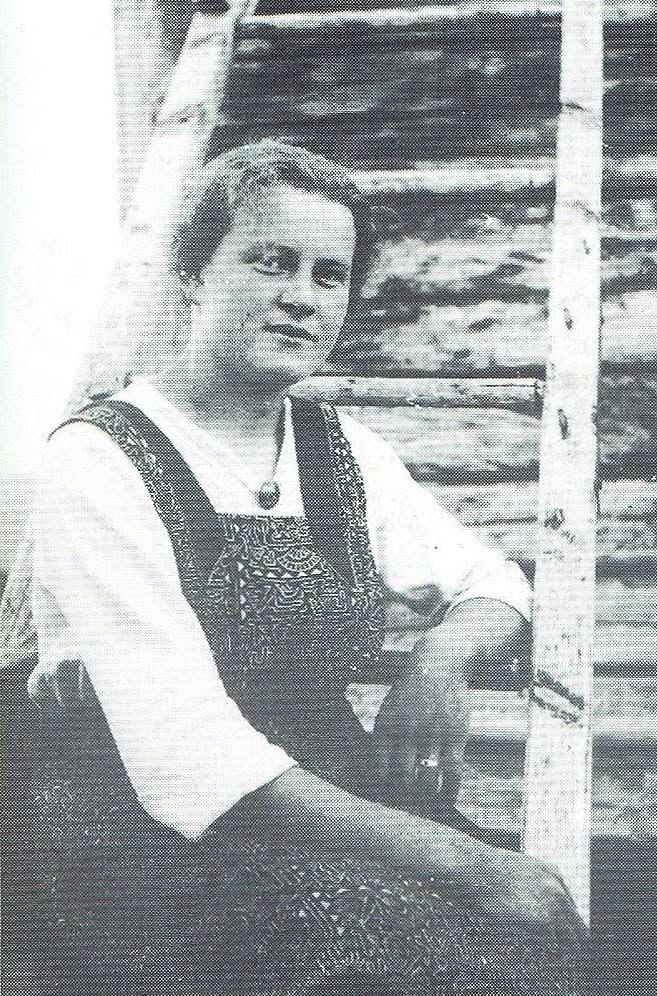
Anna Mathilda Barski seated outside a wooden building
Anna Mathilda, aged 16, at Masjok in 1927, according to the account accompanying this photograph. Photograph credited there to Samuli Paulaharju, Museiverket, Helsinki. This portrait was taken years after the childhood story below. Open larger photograph.

Hans, Anna and the wolves

This family story was passed down by Einar Henninen, Anna’s son. The account preserved in the family collection places it in Masjok in March 1913, when Hans was eleven and his little half-sister Anna had recently turned two.

Hans had taken Anna out on a sled from their home at Larsnes. They crossed the river toward the road and headed in the direction of Masjok bridge. Near the gate at Masjoknes, where Mathilde and Johan Abraham Salamonsen lived, the account says five wolves surrounded the children.

Johan Abraham’s hearing was poor, but he thought he heard cries for help. He went outside, saw the children and approached the wolves, shouting. The animals backed away. He brought Hans and Anna indoors and comforted them; later, with his rifle over his shoulder, he escorted them home to Larsnes.

The story preserves a vivid memory of Hans and Anna as children. It is presented here as a family account attributed to Einar, rather than as an independently verified report of the encounter.

Anna, Andreas and Randi
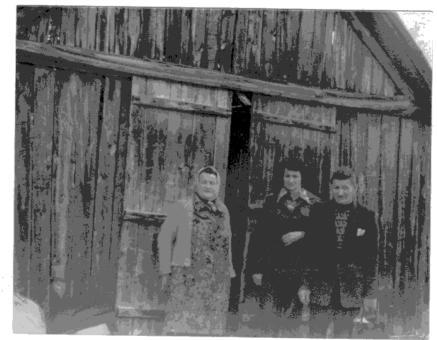
Anna, Andreas and Randi
Anna Mathilde Barski with her husband Andreas Henninen and their daughter Randi in the middle. Date unknown. Photograph supplied by Einar Henninen, reproduced in Thormod Holti’s Masjok-eiendommer (2016), p. 18.

Remembering Anna

Anna died at Tana health centre on August 26, 1995. Her family’s notice remembers a beloved wife, mother, grandmother, great-grandmother and aunt. Her husband Andreas and children Randi, Kjell, Einar and Idar are named among those mourning her. The funeral was announced for September 1 at Tana Church.
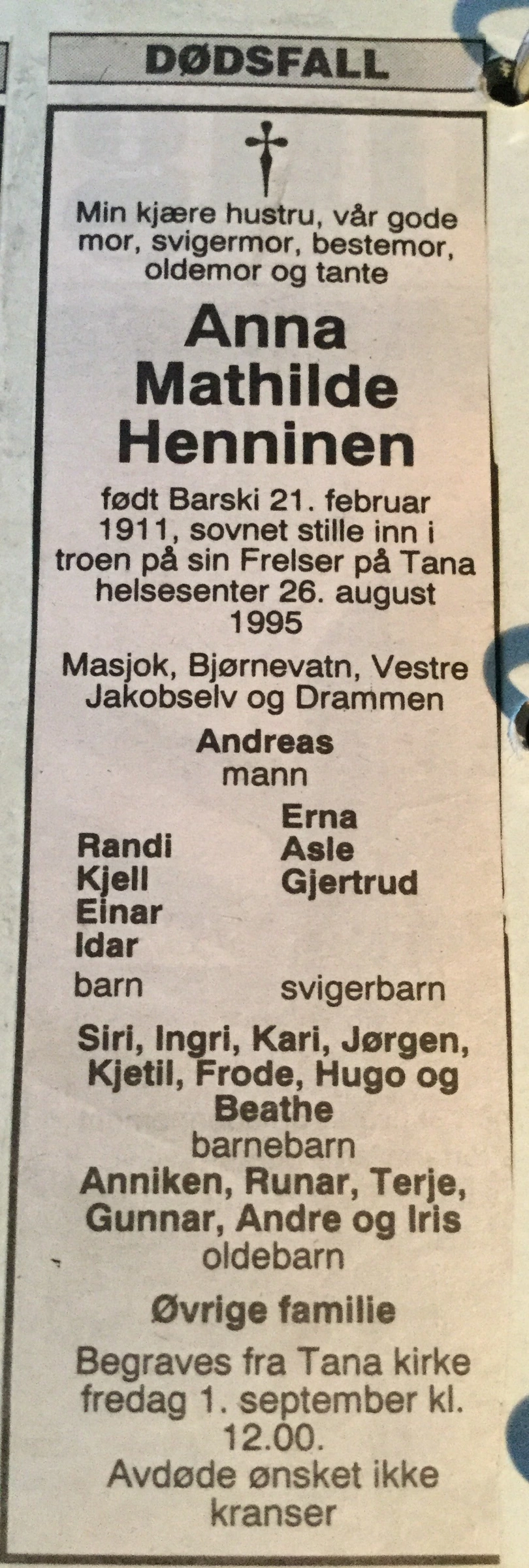
Anna Mathilde Henninen, née Barski: family death notice, 1995. Newspaper and publication date unknown.
English translation of the notice

My dear wife, our dear mother, mother-in-law, grandmother, great-grandmother and aunt, Anna Mathilde Henninen, née Barski, born February 21, 1911, passed peacefully away in faith in her Saviour at Tana health centre on August 26, 1995.

Masjok, Bjørnevatn, Vestre Jakobselv and Drammen.

Andreas, husband. Randi, Kjell, Einar and Idar, children. Erna, Asle and Gjertrud, children-in-law.

Siri, Ingri, Kari, Jørgen, Kjetil, Frode, Hugo and Beathe, grandchildren. Anniken, Runar, Terje, Gunnar, Andre and Iris, great-grandchildren. Other family.

Funeral from Tana Church on Friday, September 1, at 12 noon. The deceased did not wish for wreaths.

Help tell this story

If you have a photograph, letter or memory to add, I’d love to hear from you. You can share things just for the family archive; nothing is published without permission.

Records behind this story

Family relationships and the 2025 visit: information supplied by Isaac, including Einar’s relationship to John. The wolf story is paraphrased from the Norwegian account “Da ulvene herjet i Tana,” preserved in “Hans Harjo Information and Stories.docx” and attributed there to Einar Henninen. Its original publication details remain to be established. Isaac identified the supplied portrait as the photograph accompanying that account; its date and photographer credit follow the account. These family sources are distinguished from the census evidence.

Do you remember more of the story?

A name, a small memory, or a correction can help us get to know our family better. Send it privately to Isaac, and choose whether it may be shared.

Share a memory or correction

In the Newspapers

Family moments, remembered lives and news from the places they called home. Open a clipping to read more. Explore the whole family’s newspaper collection.

Finnmarken · December 6, 1960 · p. 3Anna Henninen named in a patient-hotel fundraising challenge

English summary

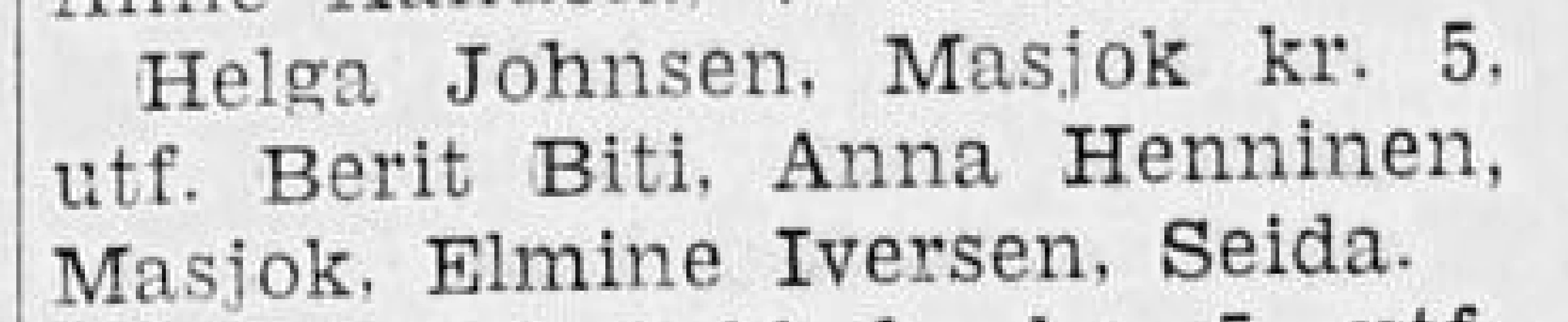
In December 1960, Helga Johnsen donated five kroner towards the patient hotel and challenged Anna and two other women to join in. It is a small glimpse of the local circle around Anna.

English translation of the selected passage

Fundraising drive for the patient hotel.

Helga Johnsen, Masjok: 5 kroner. Challenges Berit Biti and Anna Henninen, Masjok, and Elmine Iversen, Seida.

Anna Henninen named in a patient-hotel fundraising challenge · 1/2Enlarge clipping ⤢
Clipping 1 / 2
Anna Henninen named in a patient-hotel fundraising challenge · 2/2Enlarge clipping ⤢
Clipping 2 / 2
Finnmarken · November 3, 1969 · p. 8Anna Henninen is nominated for Tana’s parish council

English summary

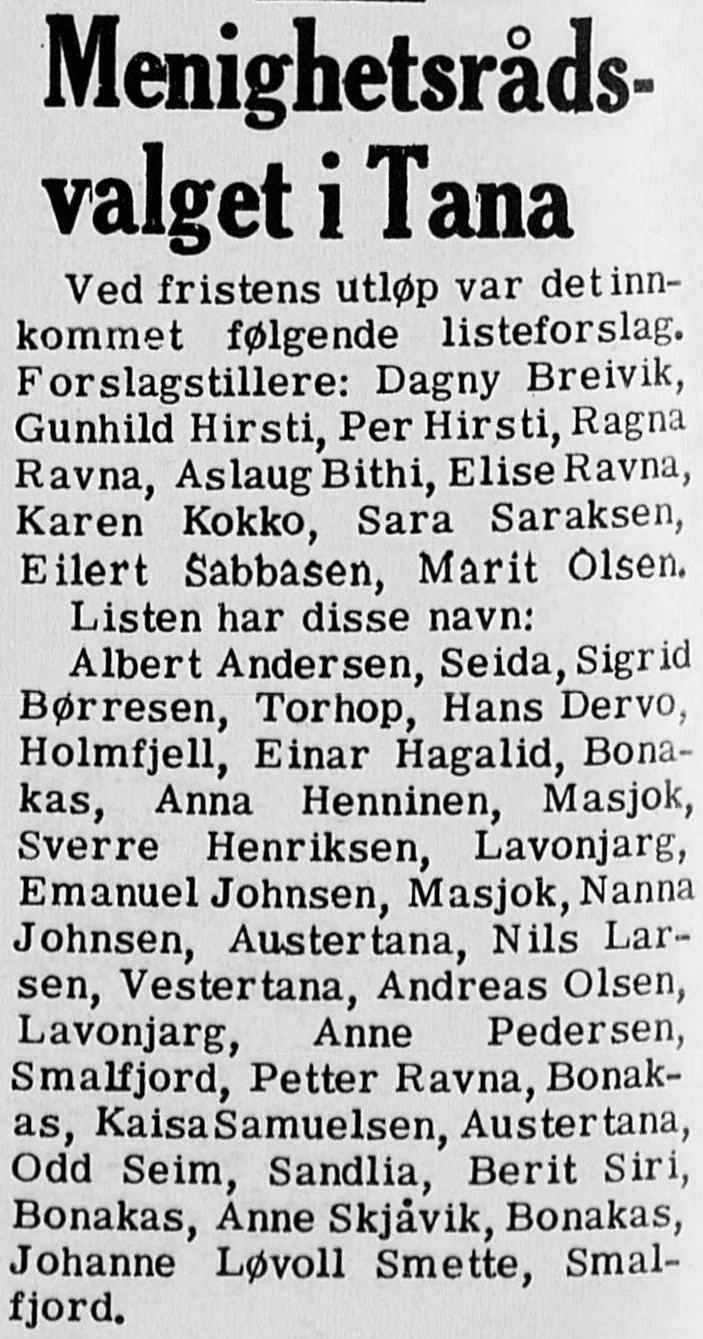
Anna was among the people nominated for Tana’s parish council in November 1969. She is listed with Masjok as her home.

English translation

The parish-council election in Tana

By the deadline, the following proposed list had been received.
Proposers: Dagny Breivik, Gunhild Hirsti, Per Hirsti, Ragna Ravna, Aslaug Bithi, Elise Ravna, Karen Kokko, Sara Saraksen, Eilert Sabbasen, Marit Olsen.

The list contains these names:
Albert Andersen, Seida;
Sigrid Børresen, Torhop;
Hans Dervo, Holmfjell;
Einar Hagalid, Bonakas;
Anna Henninen, Masjok;
Sverre Henriksen, Lavonjarg;
Emanuel Johnsen, Masjok;
Nanna Johnsen, Austertana;
Nils Larsen, Vestertana;
Andreas Olsen, Lavonjarg;
Anne Pedersen, Smalfjord;
Petter Ravna, Bonakas;
Kaisa Samuelsen, Austertana;
Odd Seim, Sandlia;
Berit Siri, Bonakas;
Anne Skjåvik, Bonakas;
Johanne Løvoll Smette, Smalfjord.

Finnmarken · December 4, 1969 · p. 5Anna Henninen becomes a deputy on Tana’s parish council

English summary

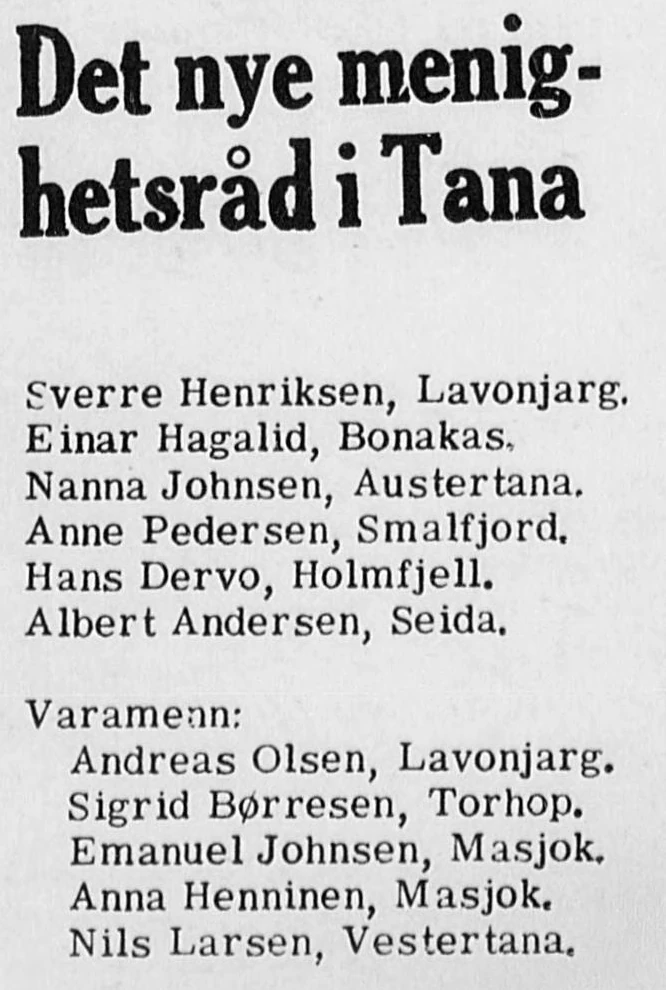
The following month’s election results named Anna as a deputy member of Tana’s parish council. She appears fourth in the list of deputies.

English translation

The new parish council in Tana

Sverre Henriksen, Lavonjarg.
Einar Hagalid, Bonakas.
Nanna Johnsen, Austertana.
Anne Pedersen, Smalfjord.
Hans Dervo, Holmfjell.
Albert Andersen, Seida.

Deputies:
Andreas Olsen, Lavonjarg.
Sigrid Børresen, Torhop.
Emanuel Johnsen, Masjok.
Anna Henninen, Masjok.
Nils Larsen, Vestertana.

Finnmarken · June 20, 1984 · p. 23Anna and Andreas celebrate fifty years together

English summary

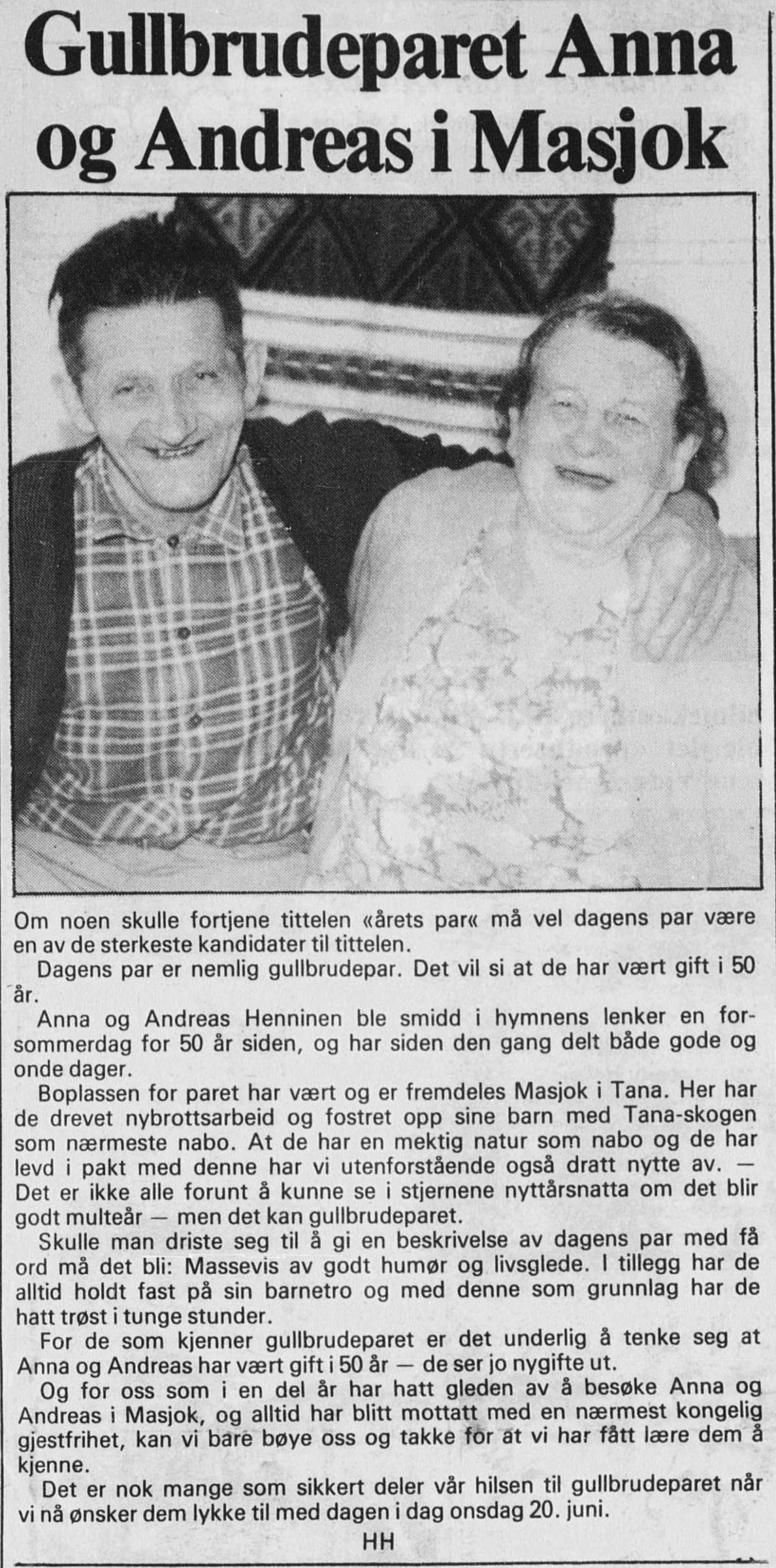
Finnmarken celebrates Anna and Andreas Henninen’s fiftieth wedding anniversary on 20 June 1984, alongside a photograph of them together. They had made their home in Masjok, clearing land and raising their children beside the Tana forest. The writer, signing HH, remembers their warmth, humour and pleasure in life, and the generous welcome visitors received. Their Christian faith had sustained them through difficult times. Living close to nature had also given them knowledge they shared with others; the article recalls their belief that the stars on New Year’s night could foretell the cloudberry harvest.

English translation

Golden-wedding couple Anna and Andreas in Masjok

If anyone deserves the title “couple of the year,” today’s couple must be among the strongest candidates.

For today’s couple are celebrating their golden wedding. That means they have been married for fifty years.

Anna and Andreas Henninen were joined in matrimony one early summer’s day fifty years ago, and since then they have shared both good days and bad.

Their home has been, and still is, Masjok in Tana. Here they have cleared new land and brought up their children, with the Tana forest as their nearest neighbor. Those of us outside the family have also benefited from their having such magnificent nature on their doorstep and living in harmony with it. Not everyone can tell from the stars on New Year’s night whether there will be a good cloudberry harvest—but this golden-wedding couple can.

If one dared describe today’s couple in a few words, they would have to be: an abundance of good humor and joy in life. They have also always held fast to the faith of their childhood, and it has given them comfort in difficult times.

For those who know them, it is strange to think that Anna and Andreas have been married for fifty years—they look like newlyweds.

And those of us who for some years have had the pleasure of visiting Anna and Andreas in Masjok, and have always been received with almost royal hospitality, can only bow our heads and give thanks that we have been able to get to know them.

Many will surely join us in sending greetings to the golden-wedding couple as we wish them happiness on their special day today, Wednesday, June 20.

HH

Finnmarken · October 1, 1990 · p. 5Anna and Andreas at Masjok

English summary

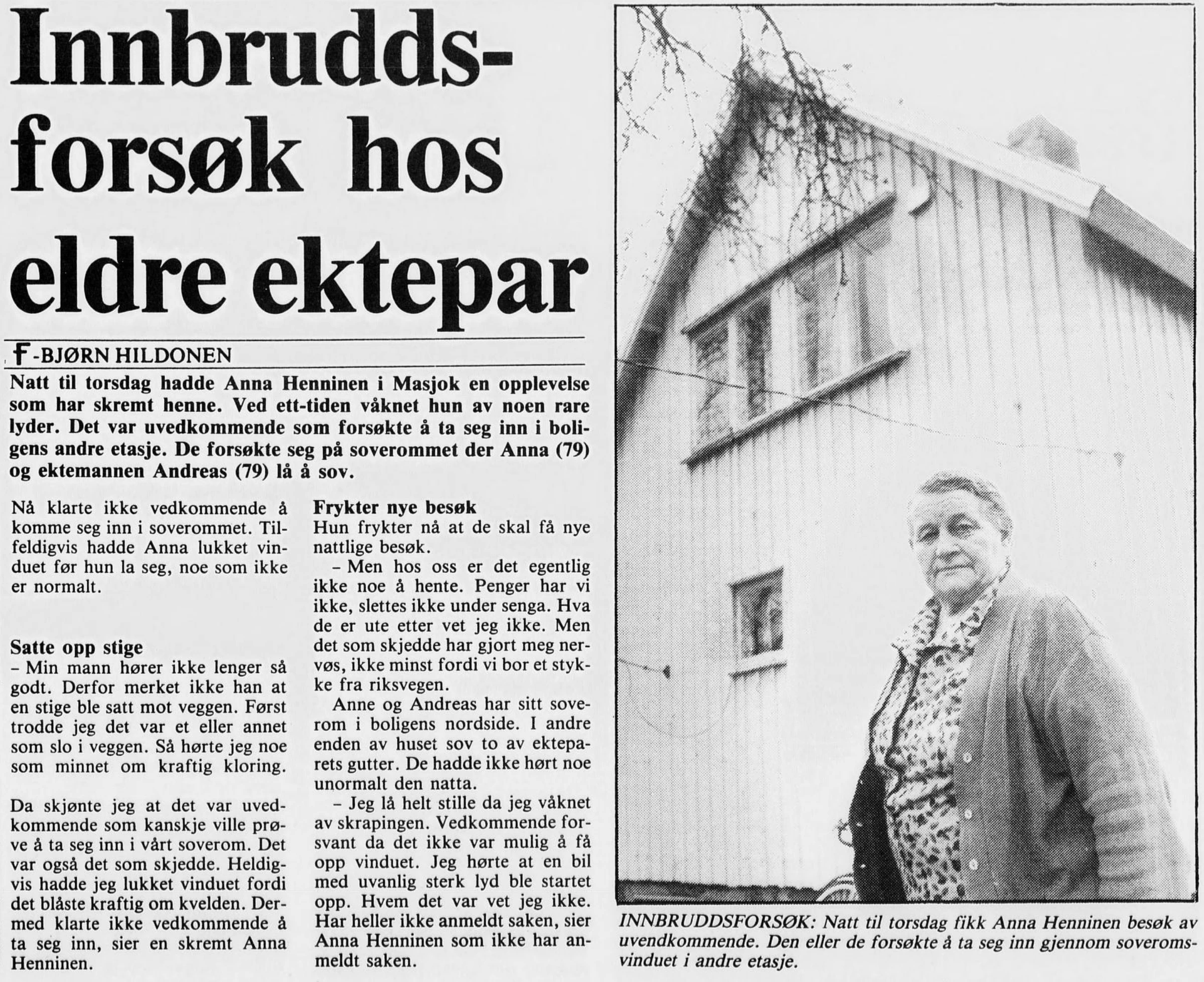
An attempted break-in disturbed Anna and Andreas’s home in Masjok in September 1990. Anna told reporter Bjørn Hildonen how frightened she had been. The intruder did not get inside. The article includes a photograph of Anna outside their house.

English translation

Attempted break-in at an elderly couple’s home

By Bjørn Hildonen

During the night before Thursday, Anna Henninen in Masjok had an experience that frightened her. Around one o’clock she woke to some strange noises. Someone was trying to get into the second floor of the house. They tried the bedroom where Anna, 79, and her husband Andreas, 79, were sleeping.

The intruder did not manage to get into the bedroom. As it happened, Anna had closed the window before going to bed, something she did not usually do.

Put up a ladder

“My husband can no longer hear very well. That was why he did not notice a ladder being placed against the wall. At first I thought something was knocking against the wall. Then I heard something like loud scratching.

“Then I realized that someone was there who might be trying to get into our bedroom. And that was exactly what was happening. Fortunately, I had closed the window because it was very windy that evening. That meant the person could not get in,” a frightened Anna Henninen says.

Fears further visits

She now fears that they will have more nighttime visitors.

“But there is really nothing to take from us. We have no money, certainly none under the bed. I do not know what they were after. But what happened has made me nervous, especially because we live some distance from the main road.”

Anna and Andreas have their bedroom on the north side of the house. Two of the couple’s sons were sleeping at the other end of the house. They had heard nothing unusual that night.

“I lay completely still when the scraping woke me. The person left when it proved impossible to open the window. I heard a car with an unusually loud engine being started. I do not know who it was. Nor have I reported the matter,” says Anna Henninen, who has not reported it to the police.

Photograph caption: ATTEMPTED BREAK-IN: During the night before Thursday, Anna Henninen had an unwelcome visitor. The person or people tried to get in through the second-floor bedroom window.

Finnmarken · October 23, 1990 · p. 16Hans Kristian’s death notice from the family in Norway

English summary

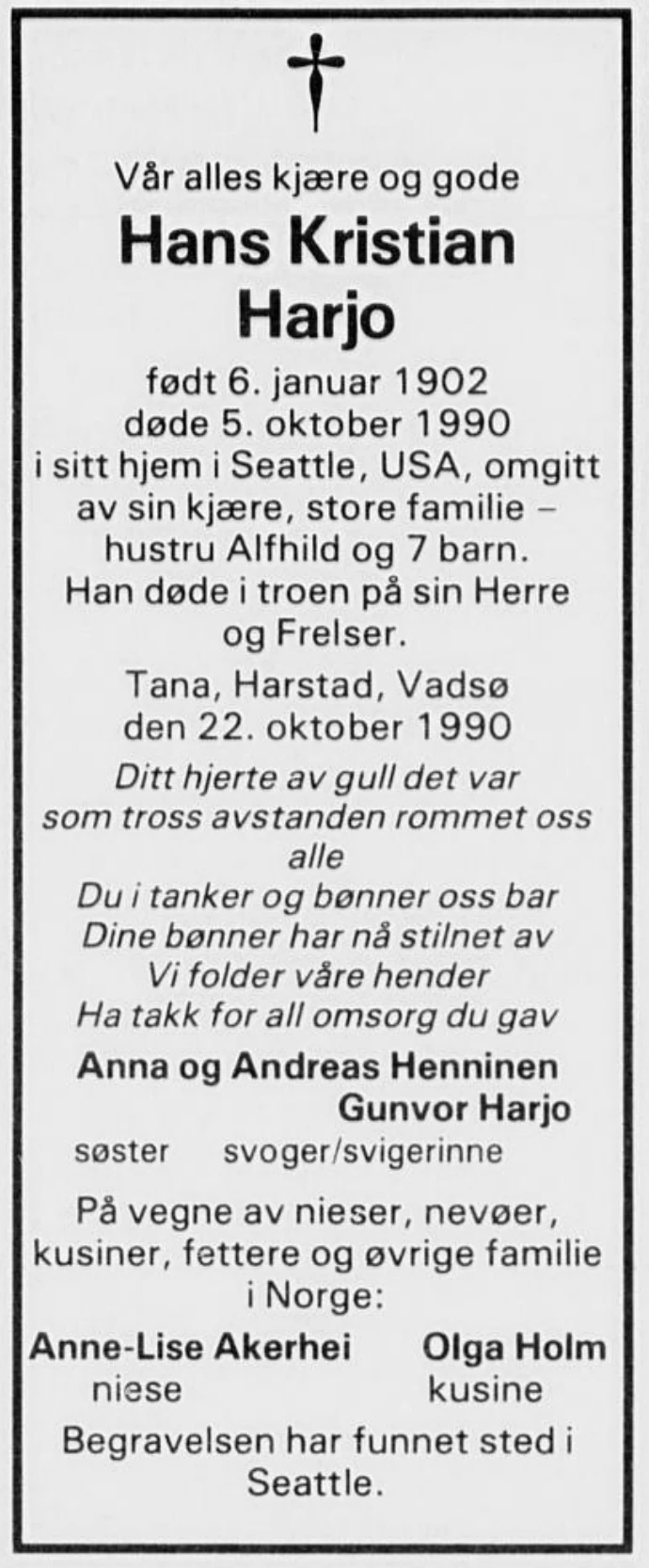
The family in Norway remembered Hans after his death at home in Seattle on October 5, 1990, with Alfhild and their seven children around him. Anna and Andreas Henninen, Gunvor Harjo, Anne-Lise Akerhei and Olga Holm are named in this farewell from relatives in Tana, Harstad and Vadsø. His funeral had already taken place in Seattle.

English translation

Our dear and kind
Hans Kristian Harjo,
beloved by us all,
born January 6, 1902,
died October 5, 1990,
at his home in Seattle, USA, surrounded by his dear, large family—his wife Alfhild and seven children.
He died in faith in his Lord and Savior.

Tana, Harstad, Vadsø,
October 22, 1990

Yours was a heart of gold,
which, despite the distance, held us all.
You carried us in your thoughts and prayers.
Your prayers have now fallen silent.
We fold our hands.
Thank you for all the care you gave.

Anna and Andreas Henninen
Gunvor Harjo
Sister, brother-in-law and sister-in-law

On behalf of nieces, nephews, cousins and the rest of the family in Norway:
Anne-Lise Akerhei, niece
Olga Holm, cousin

The funeral has taken place in Seattle.

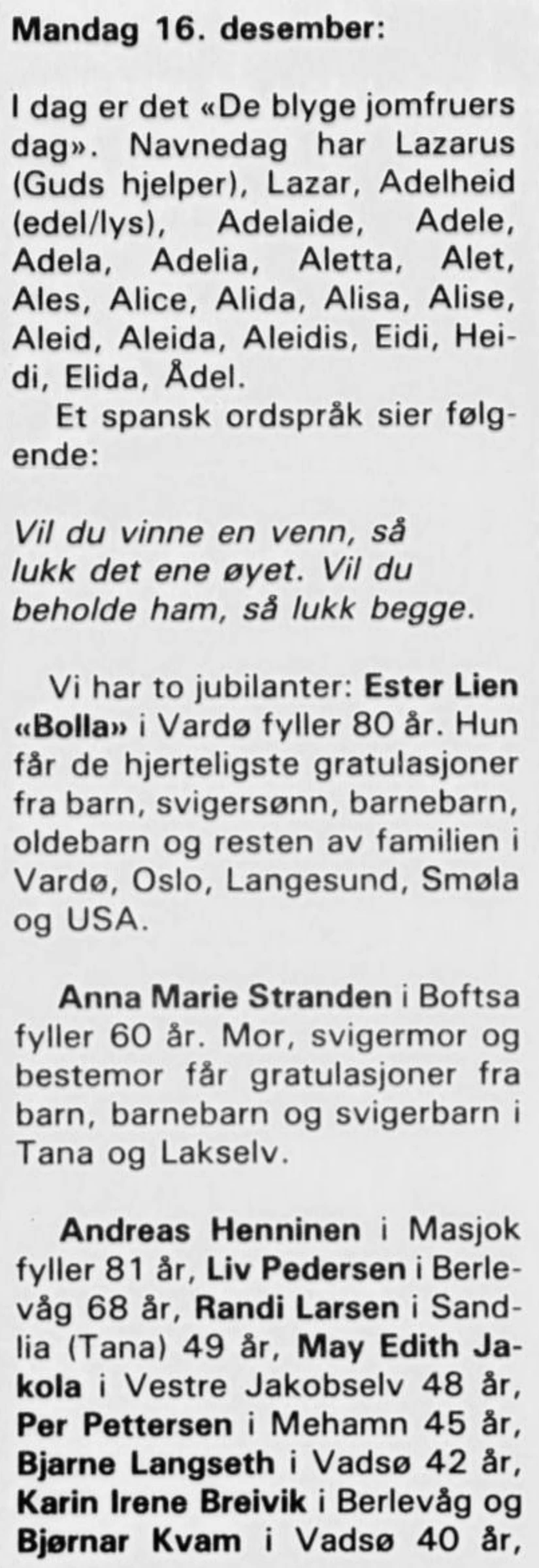
Finnmarken · December 16, 1991 · p. 23Andreas turns 81

English summary

Andreas celebrated his eighty-first birthday in Masjok on December 16, 1991. A few lines in the newspaper marked the day.

English translation

Monday, December 16: Andreas Henninen, Masjok, turns 81.

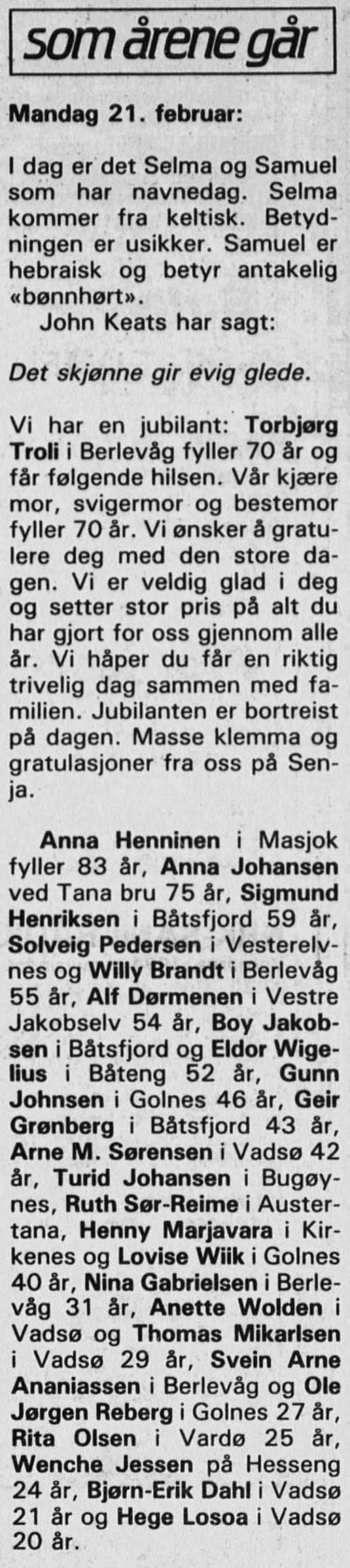
Finnmarken · February 21, 1994 · p. 19Anna turns 83

English summary

Anna turned eighty-three on February 21, 1994. The birthday column sends us back to Masjok and another family celebration.

English translation

Monday, February 21: Anna Henninen, Masjok, turns 83.

Family death notice · 1995 · publication date unknownRemembering Anna Mathilde

English summary

Anna died at Tana health centre on August 26, 1995. Her family remembered a beloved wife, mother, grandmother, great-grandmother and aunt. Her funeral was announced for September 1 at Tana Church.

English translation

My dear wife, our dear mother, mother-in-law, grandmother, great-grandmother and aunt, Anna Mathilde Henninen, née Barski, born February 21, 1911, passed peacefully away in faith in her Saviour at Tana health centre on August 26, 1995.

Masjok, Bjørnevatn, Vestre Jakobselv and Drammen.

Andreas, husband. Randi, Kjell, Einar and Idar, children. Erna, Asle and Gjertrud, children-in-law.

Siri, Ingri, Kari, Jørgen, Kjetil, Frode, Hugo and Beathe, grandchildren. Anniken, Runar, Terje, Gunnar, Andre and Iris, great-grandchildren. Other family.

Funeral from Tana Church on Friday, September 1, at 12 noon. The deceased did not wish for wreaths.

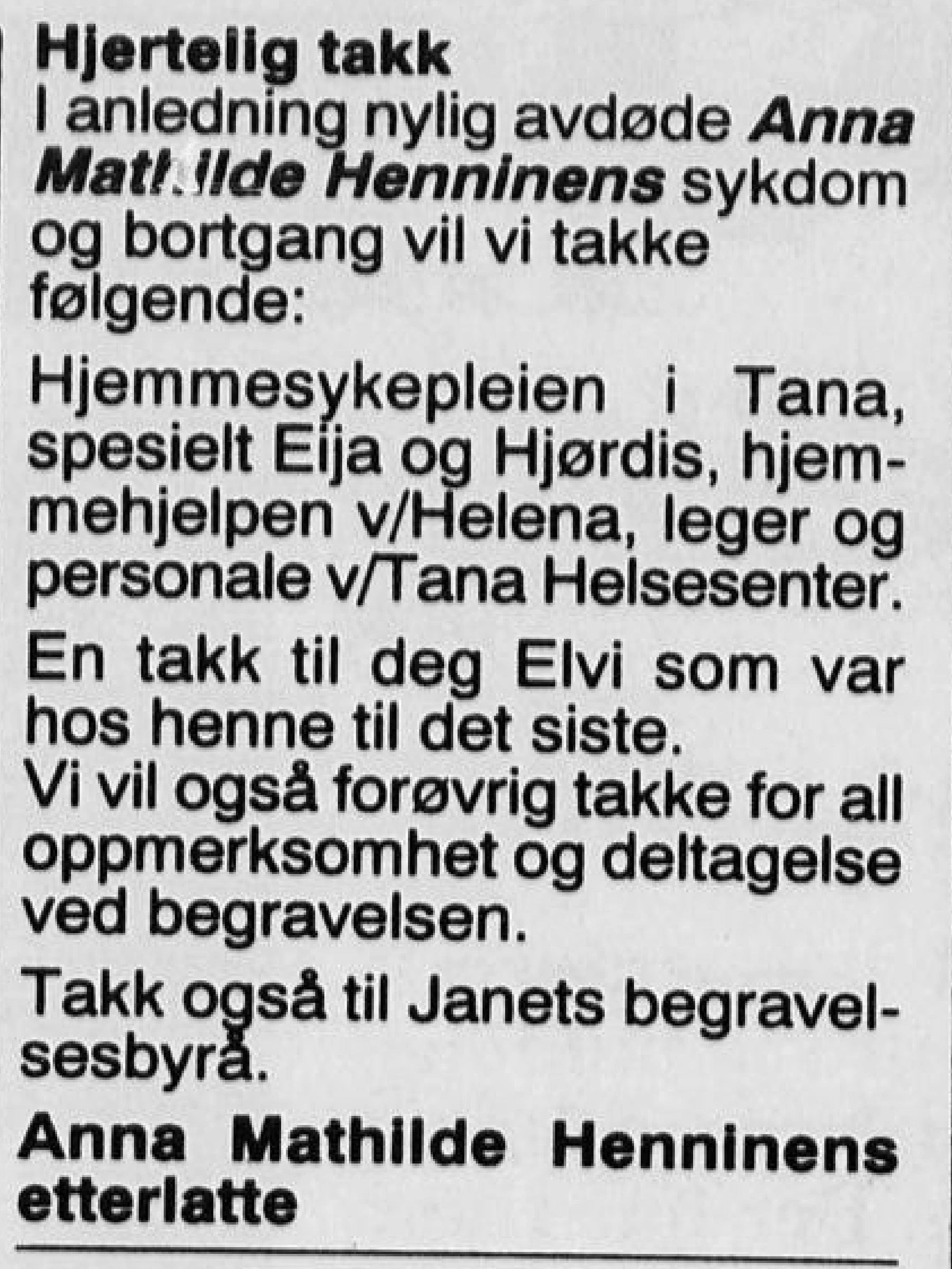
Finnmarken · September 6, 1995 · p. 18The family's thanks after Anna's death

English summary

After Anna’s death, her family thanked the people who had cared for her: Tana’s home nurses, especially Eija and Hjørdis; Helena from the home-help service; the staff at Tana health centre; and Elvi, who stayed with her until the end. They also thanked everyone who offered sympathy or attended the funeral, and Janets funeral service.

English translation

Heartfelt thanks

Following the illness and passing of the recently deceased Anna Mathilde Henninen, we would like to thank the following:

The home nursing service in Tana, especially Eija and Hjørdis; Helena from the home-help service; and the doctors and staff at Tana Health Centre.

Thank you, Elvi, for staying with her until the end.

We would also like to thank everyone for their kindness and sympathy, and for attending the funeral.

Thanks also to Janets Funeral Service.

Anna Mathilde Henninen’s surviving family

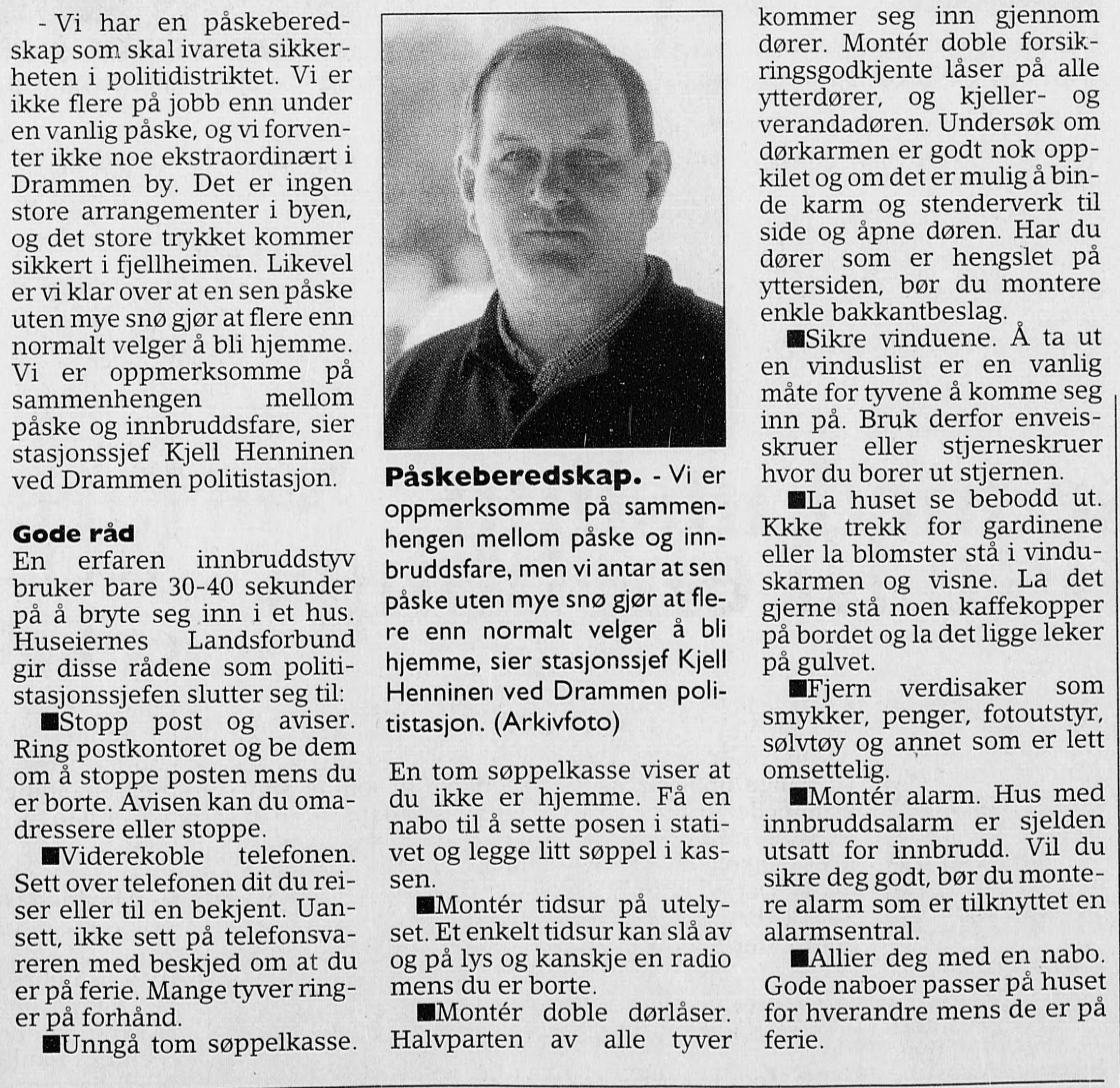
Drammens Tidende · April 15, 2000 · p. 3Kjell Henninen discusses Easter policing in Drammen

English summary

Drammen police station chief Kjell Henninen discusses preparations for Easter with Drammens Tidende. He expects routine staffing and no unusual pressure in the city, while noting that a late Easter with little snow may keep more people at home. The article discusses the police response to repeat burglars and offers household security advice endorsed by Henninen, including making homes appear occupied and arranging help from neighbors. A portrait identifies him as station chief. The statements about detention are attributed to another officer, Erik Grundstrøm, rather than to Kjell.

English translation

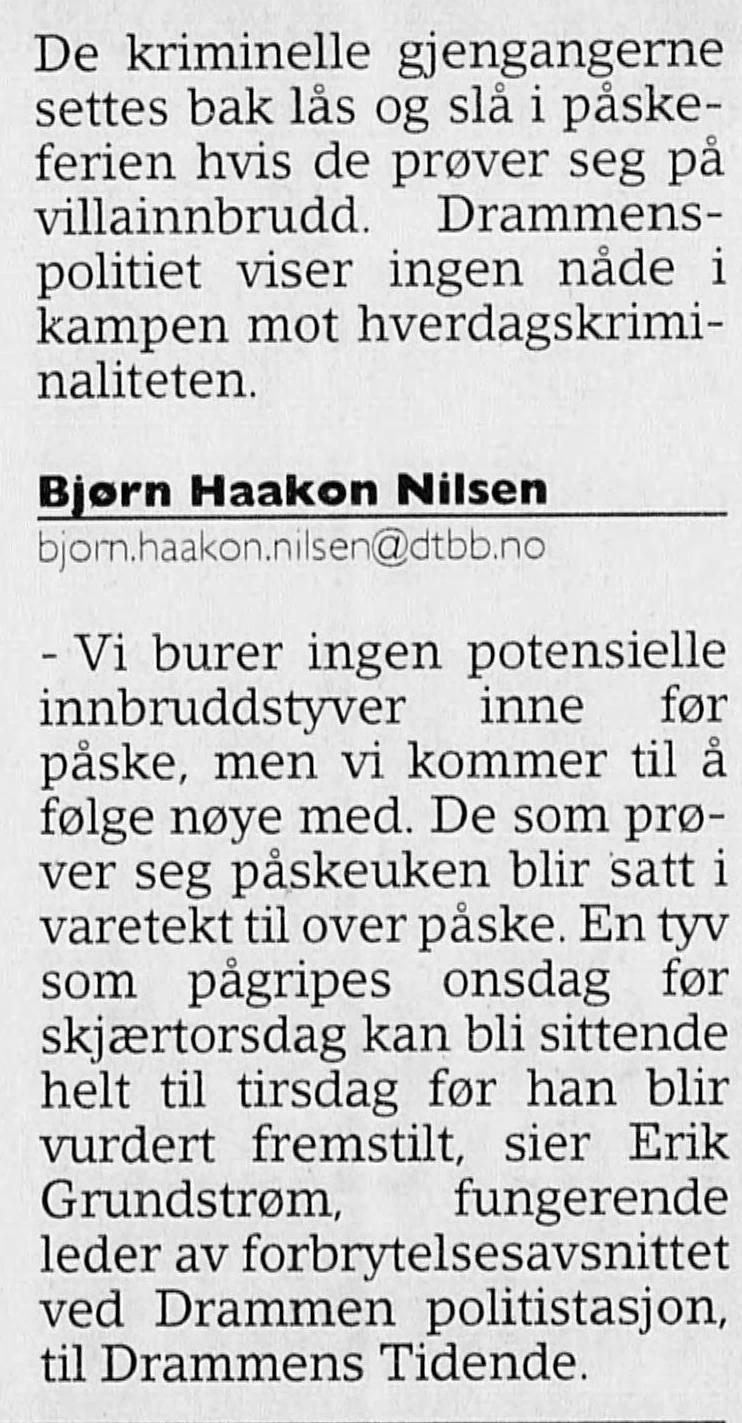
Easter thieves go straight to jail

Repeat offenders will be put behind bars over the Easter holiday if they try to burgle houses. Drammen police are showing no mercy in the fight against everyday crime.

By Bjørn Haakon Nilsen
Printed contact: bjorn.haakon.nilsen@dtbb.no

“We are not locking up any potential burglars before Easter, but we will be watching closely. Those who try their luck during Easter week will be held in custody until after Easter. A thief arrested on the Wednesday before Maundy Thursday could remain in custody until Tuesday before a court appearance is considered,” Erik Grundstrøm, acting head of the crime section at Drammen police station, tells Drammens Tidende.

“Our Easter arrangements are intended to maintain safety in the police district. We have no more people at work than during a normal Easter, and we do not expect anything out of the ordinary in Drammen. There are no major events in the city, and the greatest pressure will probably be in the mountains. Nevertheless, we know that a late Easter without much snow means more people than usual choose to stay at home. We are aware of the connection between Easter and the risk of burglary,” says Drammen police station chief Kjell Henninen.

Good advice

An experienced burglar needs only thirty to forty seconds to break into a house. The Norwegian Homeowners’ Association offers the following advice, which the station chief endorses:

• Stop mail and newspaper deliveries. Call the post office and ask it to hold your mail while you are away. Your newspaper can be redirected or suspended.
• Forward your telephone calls. Redirect calls to where you are staying or to someone you know. In any case, do not leave an answering-machine message saying you are on holiday. Many thieves call beforehand.
• Avoid an empty rubbish bin. An empty bin shows that you are not at home. Ask a neighbor to put out the bag and place some rubbish in the bin.
• Put a timer on the outdoor lighting. A simple timer can switch lights, and perhaps a radio, on and off while you are away.
• Fit two door locks. Half of all thieves enter through doors. Fit two insurance-approved locks to every exterior door, including the basement and veranda doors. Check that the door frame is properly secured and whether the frame and studs can be forced aside to open the door. If your doors have exposed external hinges, fit simple hinge-security devices.
• Secure the windows. Removing a glazing bead is a common way for thieves to get in. Use one-way screws, or cross-head screws with the cross drilled out.
• Make the house look occupied. Do not draw the curtains or leave flowers wilting on the windowsill. Leave a few coffee cups on the table and toys on the floor.
• Put away valuables such as jewelry, money, photographic equipment, silverware and other items that are easy to sell.
• Install an alarm. Houses with burglar alarms are seldom burgled. For good protection, install an alarm connected to a monitoring centre.
• Team up with a neighbor. Good neighbors look after one another’s houses while they are on holiday.

Photograph caption: EASTER READINESS. “We are aware of the connection between Easter and the risk of burglary, but we assume that a late Easter without much snow will mean that more people than usual choose to stay at home,” says Drammen police station chief Kjell Henninen. Archive photograph.

Kjell Henninen discusses Easter policing in Drammen · 1/3Enlarge clipping ⤢
Clipping 1 / 3
Kjell Henninen discusses Easter policing in Drammen · 2/3Enlarge clipping ⤢
Clipping 2 / 3
Kjell Henninen discusses Easter policing in Drammen · 3/3Enlarge clipping ⤢
Clipping 3 / 3
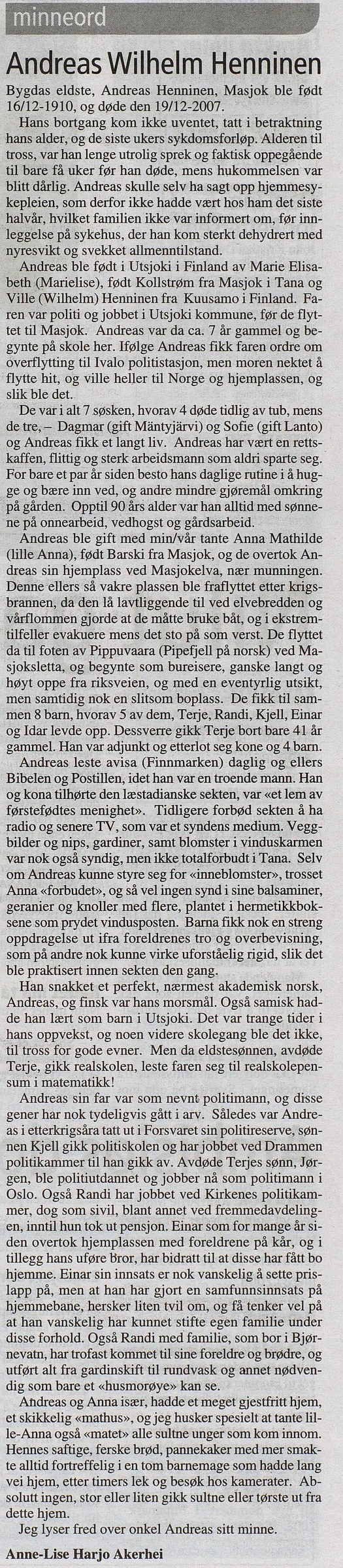
Finnmarken · February 7, 2008 · p. 21Anne-Lise remembers her uncle Andreas Wilhelm Henninen

English summary

Anne-Lise Harjo Akerhei remembers her uncle Andreas Henninen, born in Utsjoki on 16 December 1910 and deceased on 19 December 2007. His parents were Marie Elisabeth Kollstrøm of Masjok and policeman Ville (Wilhelm) Henninen of Kuusamo. He moved to Masjok at about seven. Andreas married Anna Mathilde Barski; after the wartime destruction they left their flood-prone riverside home and established a new smallholding below Pippuvaara. Five of their eight children grew up: Terje, Randi, Kjell, Einar and Idar. Anne-Lise recalls his strength, faith, languages and appetite for learning, including studying mathematics alongside his son’s schoolwork. Kjell became a policeman in Drammen, while Einar and Randi helped care for their parents. Her warmest memories are of the couple’s hospitality: Anna’s bread and pancakes fed visiting children, and everyone was welcomed.

English translation

In memoriam
Andreas Wilhelm Henninen

The village’s oldest resident, Andreas Henninen of Masjok, was born on December 16, 1910, and died on December 19, 2007.

His passing was not unexpected, considering his age and the course of his illness in recent weeks. Despite his age, he had long been remarkably fit and was still up and about until just a few weeks before he died, although his memory had deteriorated. Andreas was said to have canceled the home nursing service himself, so they had not visited him for the last six months. The family was not informed of this until he was admitted to hospital, severely dehydrated, with kidney failure and in a weakened general condition.

Andreas was born in Utsjoki, Finland, to Marie Elisabeth, known as Marielise, née Kollstrøm, from Masjok in Tana, and Ville (Wilhelm) Henninen from Kuusamo, Finland. His father was a policeman working in Utsjoki municipality before they moved to Masjok. Andreas was then about seven years old and began school here. According to Andreas, his father had been ordered to transfer to Ivalo police station, but his mother refused to move there. She wanted to go to Norway and her home place instead, and that is what happened.

There were seven siblings in all. Four died young of tuberculosis, while the other three—Dagmar, married name Mäntyjärvi; Sofie, married name Lanto; and Andreas—lived long lives. Andreas was an upright, hardworking and strong man who never spared himself. Only a couple of years ago his daily routine still consisted of chopping and carrying in firewood and doing other small jobs around the farm. Until the age of ninety, he always joined his sons in work on the surrounding land, woodcutting and farm work.

Andreas married my—our—aunt Anna Mathilde, “little Anna,” née Barski, from Masjok, and they took over Andreas’s family home by the Masjok River, near its mouth. They left this otherwise beautiful place after the wartime burning. It lay low on the riverbank, and the spring floods meant they had to use a boat and, in extreme cases, evacuate while the flooding was at its worst. They then moved to the foot of Pippuvaara, Pipefjell in Norwegian, by Masjoksletta, and began clearing a new smallholding. It was quite far from, and high above, the main road, with a marvelous view, but it must also have been a demanding place to live. They had eight children in all, of whom five—Terje, Randi, Kjell, Einar and Idar—grew up. Sadly, Terje died at only forty-one. He was a teacher and left a wife and four children.

Andreas read the newspaper, Finnmarken, every day, as well as the Bible and the book of sermons, for he was a man of faith. He and his wife belonged to the Laestadian sect, to the “congregation of the Firstborn.” In earlier times the sect forbade radios, and later television, as a medium of sin. Pictures on the walls, ornaments, curtains and flowers on the windowsill were probably also considered sinful, though not completely forbidden in Tana. Although Andreas could do without “indoor flowers,” Anna defied the “ban” and surely saw no sin in the balsams, geraniums, tubers and other plants growing in the tins that adorned her windowsill. The children probably had a strict upbringing based on their parents’ faith and convictions, which others might have found incomprehensibly rigid, as practiced within the sect at that time.

Andreas spoke perfect, almost academic Norwegian, and Finnish was his mother tongue. He had also learned Sámi as a child in Utsjoki. Times were hard during his childhood and, despite his abilities, he had no opportunity for further schooling. But when his eldest son, the late Terje, attended secondary school, his father studied the secondary-school mathematics syllabus himself!

As mentioned, Andreas’s father was a policeman, and those genes have evidently been passed down. In the postwar years Andreas was selected for the Armed Forces’ police reserve. His son Kjell attended police college and worked at Drammen police headquarters until he retired. The late Terje’s son Jørgen trained as a police officer and now works as one in Oslo. Randi also worked at Kirkenes police headquarters, though as a civilian, including in the immigration section, until she retired.

Many years ago Einar took over the family home, with an arrangement to provide for his parents and also his disabled brother. His contribution enabled them to continue living at home. It is difficult to put a price on Einar’s efforts, but there is little doubt that he has performed a service to society on the home front. Few probably think about how difficult it must have been for him to establish a family of his own under these circumstances. Randi and her family, who live in Bjørnevatn, have also faithfully visited her parents and brothers, doing everything from changing curtains to spring-cleaning and the other necessary tasks that only a “housewife’s eye” can see.

Andreas, and Anna especially, kept a wonderfully hospitable home—a real “house of food.” I particularly remember how Aunt little-Anna also “fed” every hungry child who dropped in. Her moist, fresh bread, pancakes and other food always tasted wonderful to a child with an empty stomach and a long way home after hours of playing and visiting friends. Absolutely no one, young or old, left this home hungry or thirsty.

May peace rest over the memory of Uncle Andreas.

Anne-Lise Harjo Akerhei

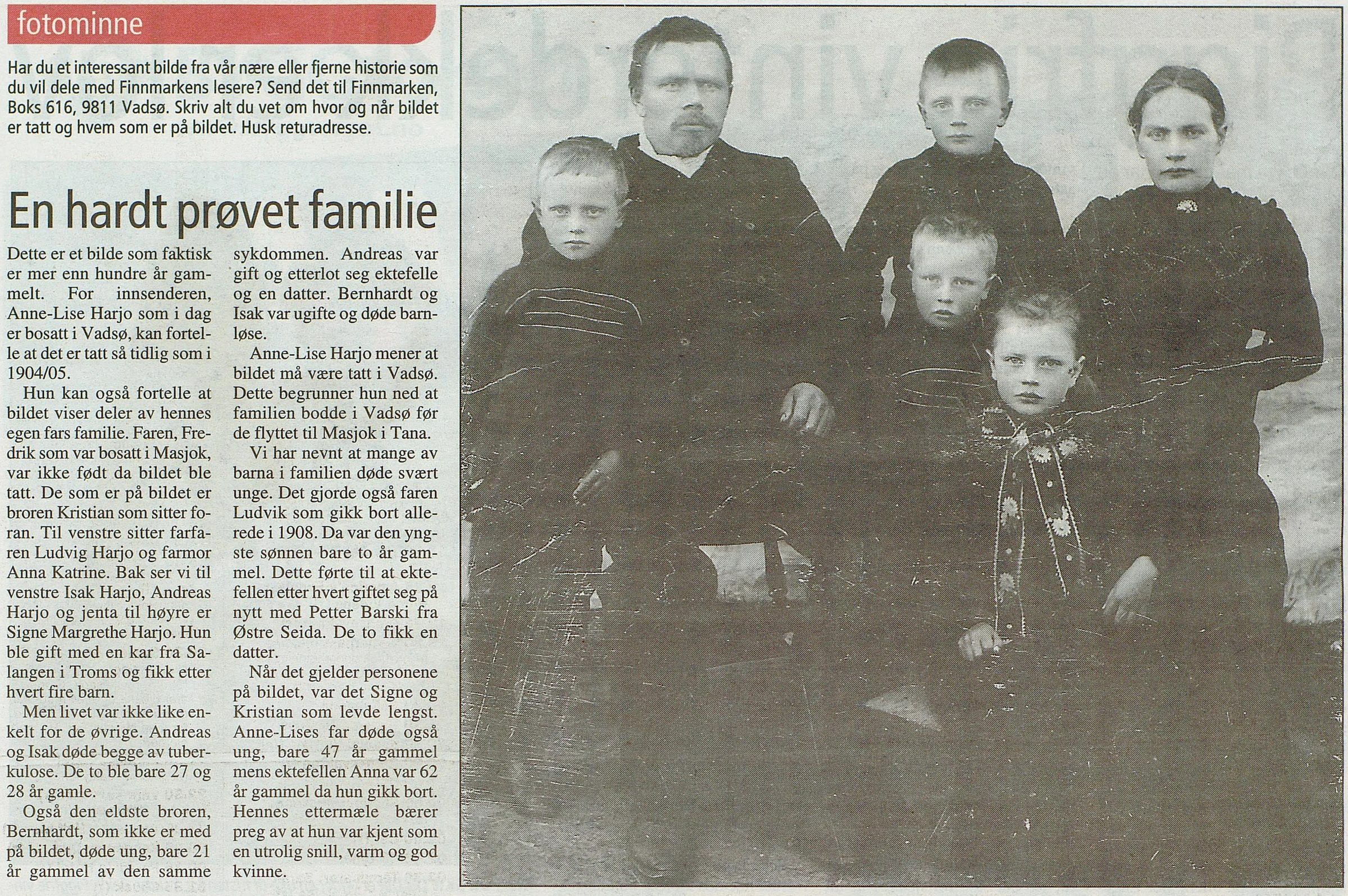
Finnmarken · April 28, 2011 · p. 23Anne-Lise shares a photograph and memories of her father’s family

English summary

Anne-Lise Harjo shares a family photograph she dates to 1904–05, probably taken in Vadsø before the move to Masjok. It shows her grandparents Ludvig and Anna with some of their children; her father Fredrik had not yet been born. She recalls the family’s losses to tuberculosis, Ludvig’s death in 1908, and Anna’s later marriage to Petter Barski of Østre Seida, with whom she had a daughter. Signe and Kristian were the longest-lived of the children pictured. Anna is remembered for her kindness and warmth.

English translation

Photo memory

Do you have an interesting photograph from our recent or distant history that you would like to share with Finnmarken’s readers? Send it to Finnmarken, P.O. Box 616, 9811 Vadsø. Write down everything you know about where and when the picture was taken and who is in it. Remember to include a return address.

A family sorely tried

This photograph is actually more than a hundred years old. Its contributor, Anne-Lise Harjo, who now lives in Vadsø, tells us that it was taken as early as 1904–05.

She also tells us that it shows members of her own father’s family. Her father, Fredrik, who lived in Masjok, had not been born when the photograph was taken. Among those pictured is his brother Kristian, seated at the front. On the left sits her grandfather Ludvig Harjo, with her grandmother Anna Katrine. At the back, on the left, we see Isak Harjo and Andreas Harjo, while the girl on the right is Signe Margrethe Harjo. She married a man from Salangen in Troms and eventually had four children.

But life was not as easy for the others. Andreas and Isak both died of tuberculosis. They were only twenty-seven and twenty-eight years old.

The eldest brother, Bernhardt, who is not in the photograph, also died young, at only twenty-one, of the same disease. Andreas was married and left a wife and a daughter. Bernhardt and Isak were unmarried and died without children.

Anne-Lise Harjo believes the photograph must have been taken in Vadsø. She bases this on the fact that the family lived in Vadsø before moving to Masjok in Tana.

We have mentioned that many of the children in the family died very young. So did their father Ludvik, who died as early as 1908. At that time, the youngest son was only two years old. His wife eventually remarried, to Petter Barski from Østre Seida. They had a daughter together.

Of the people in the photograph, Signe and Kristian lived the longest. Anne-Lise’s father also died young, at only forty-seven, while his wife Anna was sixty-two when she died. She is remembered as an incredibly kind, warm and good woman.

Translation note: The newspaper’s photograph identifications and ages are retained as printed. Its final paragraph mixes generations: Anna Katrine was Ludvig’s wife; Fredrik’s wife was Gunvor. The family’s updated identifications remain in the biographies.

Places in a Life

Follow recorded birthplaces and homes through the years. Numbers connect the map to dated records; gold marks a birthplace. Markers show approximate towns or regions, not exact houses. A recorded year does not establish an uninterrupted stay.

Anna Mathilde Barski

Recorded birth and home locations for Anna Mathilde BarskiMarch 1913 · family recollection · Home — Larsnes, Tana, Norway (regional marker); 1920 census · Home — Larsnes, Tana, Norway (regional marker)1Larsnes

Dated entries correspond to the numbered places. Enable JavaScript to select entries and zoom.

  1. Einar Henninen’s family account says Hans took Anna from their home at Larsnes. Attributed family oral history, not an independently verified account of the wolf encounter. Marker precision: broad regional marker; not a farm or village coordinate.

    Source for this place
  2. The census places Anna in the Larsnes household with Petter and Anna Barski and Isak Harjo. Marker precision: broad regional marker; not a farm or village coordinate.

    Source for this place

The profile gives January 21, 1911 as the birth date but does not establish a birthplace. The 1927 portrait at Masjok is a photographic location, not independent proof of residence.

Present-day coastline: Natural Earth. Historical place names are retained in the records. The map and dated list also remain available without JavaScript.